Life doesn’t ask if you’re rested before it starts demanding things. Kids need rides. Someone spills something sticky. Homework deadlines sneak up. Work stress hums in the background like a fridge you can’t unplug. By the time evening hits, the idea of a long, intense workout feels less like motivation and more like a bad joke.
That’s the reality most parents live in. And it’s exactly why low-impact fitness for busy parents matters more than any perfect workout plan you’ll never stick to. When fitness advice ignores stress, sleep deprivation, aging joints, mental load, emotional labor, and constant responsibility, it becomes one more thing parents feel like they’re failing at instead of something that actually helps them cope and function.
I’m not writing this from a gym floor at sunrise or between perfectly timed meals. I’m writing it from the middle of family life, where movement has to fit between responsibilities instead of competing with them. Fitness has to coexist with carpools, work deadlines, grocery runs, bills, emotional regulation, and the quiet exhaustion that comes from being needed all day long.
Here’s the part nobody wants to admit: for most parents, the problem isn’t desire. It’s friction. The version of fitness we’re sold requires ideal conditions. And ideal conditions are a myth once you’ve got kids, a job, and a brain that feels like it’s running thirty tabs at once.
A Real-Life Snapshot: How Fitness Actually Breaks Down 😅
Most days don’t fail because you didn’t care. They fail because time dissolves in tiny pieces.
You plan to exercise after dinner. Dinner runs long. One kid can’t find a charger. Another suddenly remembers a project due tomorrow. The dog needs to go out. You check the clock and it’s 9:12 PM. At that point, it’s not about willpower anymore. It’s about energy debt.
This is where low-impact fitness for busy parents quietly succeeds. It doesn’t demand heroics. It rewards actions small enough to survive chaos.
Parent takeaway: If your fitness plan needs perfect timing, it will fail. If it works inside disorder, it will last.
The Two-Minute Trap
What kills most workouts isn’t one big interruption. It’s ten tiny ones. Two minutes finding shoes. Two minutes answering a text. Two minutes helping with a snack. Two minutes scrolling because your brain is fried. Suddenly your “quick session” is gone.
Low-impact fitness works because it reduces setup friction. When movement is immediately accessible, starting becomes possible.
📝 Practical shortcut: Keep one movement option permanently ready. A resistance band on a doorknob. Shoes by the door. A mat in the corner. The less setup required, the more likely movement actually happens.
Why Traditional Fitness Advice Breaks Down for Parents 😵💫
Most fitness programs assume predictable time, predictable sleep, and predictable recovery. Parents rarely have any of those.
When sleep is inconsistent and stress is constant, high-intensity routines don’t just feel hard. They quietly drain you. Soreness lingers longer than it used to. Motivation fades not because you don’t care, but because your nervous system is already overloaded before the workout begins.
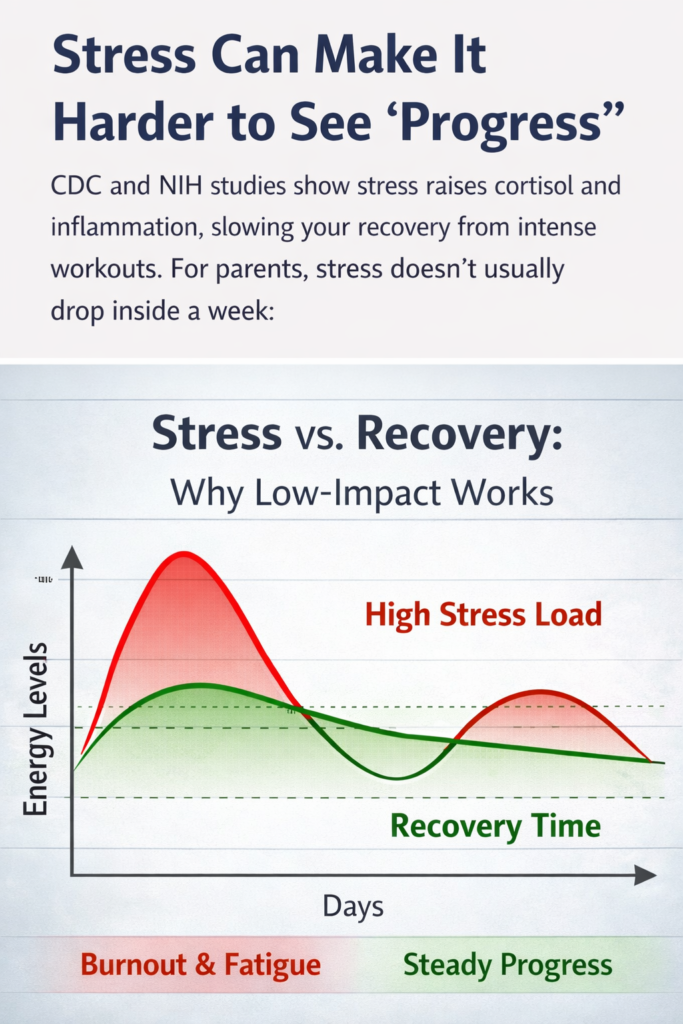
Stress fundamentally changes recovery. Cortisol stays elevated. Inflammation rises. Muscles repair more slowly. Joints stay irritated. Add parenting responsibilities on top of that and pushing harder doesn’t make you stronger. It makes you irritable, exhausted, and more likely to quit.
This isn’t a discipline problem. It’s a design problem.
A Dad-in-His-40s Moment: When Intensity Stopped Working 🧠
There was a stretch where every workout felt like a setback. Knees aching. Lower back tight. Sleep getting worse instead of better. I kept telling myself I just needed to push through.
That mentality didn’t make me tougher. It made me inconsistent.
Once I stopped chasing intensity and started chasing repeatability, everything shifted. Shorter sessions. Slower lifts. More walking. Fewer injuries. Better sleep. And, ironically, better results.
Important note: If exercise consistently makes tomorrow worse, that’s information, not weakness.
Fitness Looks Different When You’re Carrying Responsibility 👨👩👧👦
Parent fitness isn’t about aesthetics. It’s about capacity.
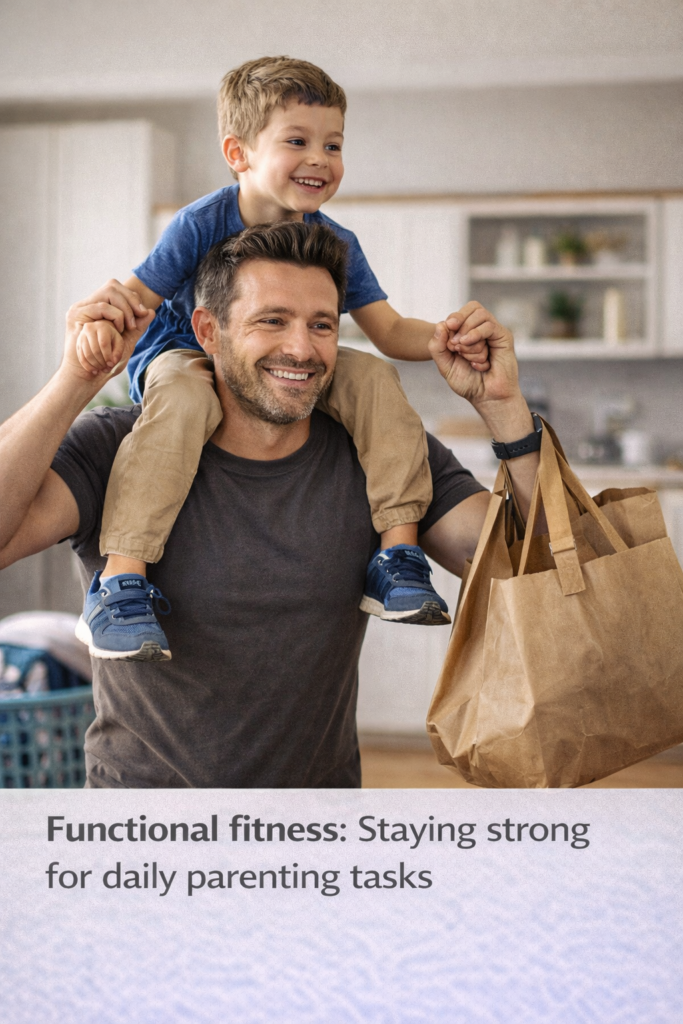
The strongest parents I know don’t look like fitness models. They’re the ones who can carry groceries and a cranky kid without tweaking a shoulder. They can get up off the floor without turning it into a production. They can function on imperfect sleep and stay calm when life gets loud.
That’s a parenting definition of strength.
Fitness for parents over 40 needs to support joints, balance, posture, coordination, grip strength, and bone density. Low-impact fitness for busy parents builds strength that shows up in real life, not just under perfect gym conditions.
When your body hurts less, your patience improves. Your focus improves. Parenting feels slightly less heavy.
📌 40s recommendation: Start caring more about how you move than how hard you move. Control and joint-friendly ranges beat ego-lifting every time.
Troubleshooting Common Parent Pain Points 🛠️
Pain is one of the biggest reasons parents quit exercising. Often, it’s because they don’t know how to interpret the signal.
The Pain Rule
Green light: Mild discomfort that improves as you warm up and feels better later.
Yellow light: Aching or sharpness that lingers into the next day or alters movement.
Red light: Pain that spikes, causes swelling, numbness, or forces compensation.
Yellow and red lights call for adjustment, not grit. If pain becomes normal, it eventually becomes chronic.
Common issues and smart responses
Knee pain: Reduce impact first, not movement. Prioritize walking on flat ground and strengthen hips gradually.
Lower back tightness: Avoid max lifts. Add daily walking and short mobility sessions. Sit less, move more often.
Foot pain / plantar fasciitis: Supportive shoes matter. Short walks beat long painful ones. Gentle calf mobility helps.
Reminder: Pain that persists for weeks deserves professional input, not more willpower.
Why Low-Impact Fitness for Busy Parents Actually Works 🚶♂️🏋️♂️
Low-impact doesn’t mean low effort. It means low damage.
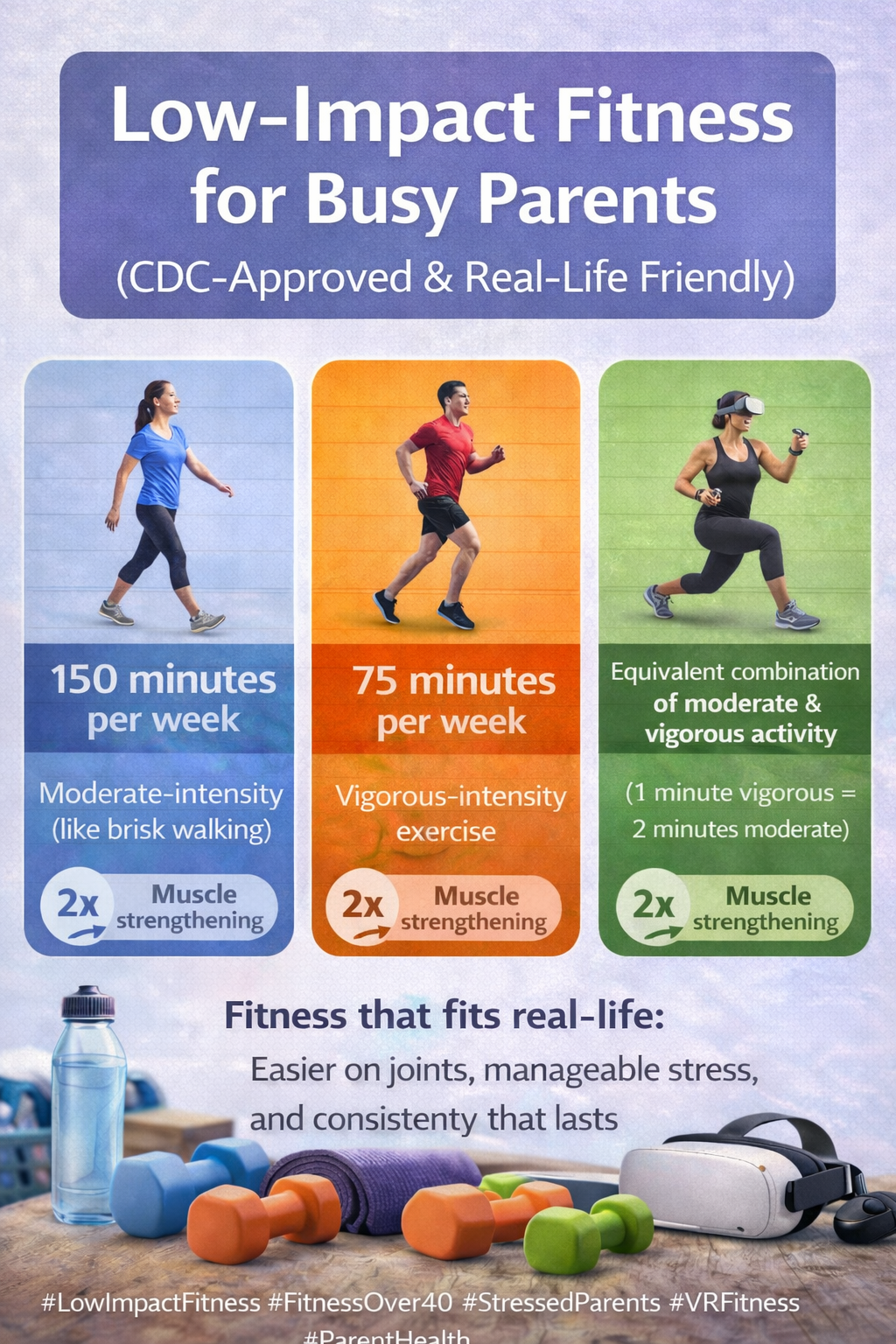
Walking, controlled strength training, balance work, and mobility allow parents to stay active without overwhelming joints or the nervous system. Consistency compounds. Recovery improves. Energy stabilizes.
Energized (25–45 min): Longer walk, moderate strength (no maxing), VR with a short finisher.
Rule: Choose the level that fits today, not the one you wish you had energy for.
A Weekly Template That Survives Chaos 📅
Some weeks fall apart. Sick kids. Extra work. Stress. Life.
A minimum effective week still counts:
Two short walks
One light strength session
Two brief mobility resets
That keeps the habit alive so you don’t restart from zero.
Example week:
Mon: Walk + mobility
Tue: Strength
Wed: Easy walk or VR
Thu: Strength
Fri: Active family time
Sat: Longer walk or VR
Sun: Recovery movement
Making Fitness Family-Friendly Instead of Isolating 👟
Guilt stops more parents from exercising than laziness.
Low-impact movement fits into family life. Walks together. Stretching while kids play. Strength work while homework happens nearby. Fitness becomes visible, normal, and repeatable.
Where VR Fitness Fits Into Real Life 🎮🕶️
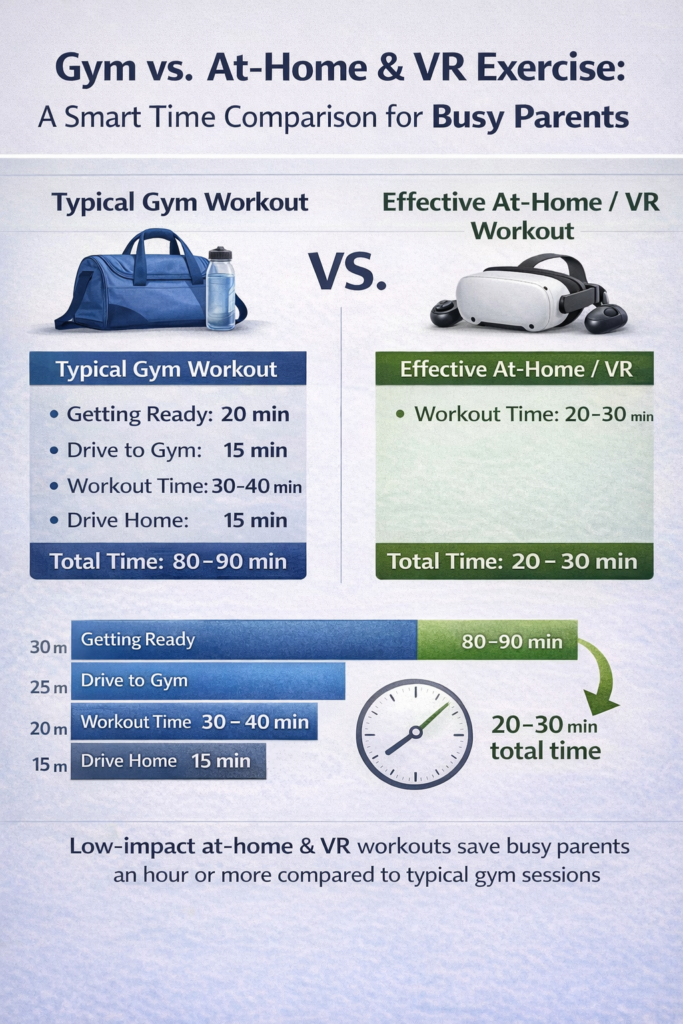
VR removes friction. No weather. No commute. No setup.
VR safety basics
Warm up shoulders, hips, and ankles
Clear the play space
Start slow on pivots and twists
Stop before exhaustion sneaks up
What works best for parents
Rhythm/cardio games for stress relief
Boxing-style workouts with shoulder awareness
Low-impact programs for consistency
Gamified movement when boredom kills motivation
Why it works: VR makes movement feel like play, not obligation.
Stress Is the Real Opponent 🧠🔥
Before choosing intensity, check your nervous system. Poor sleep, irritability, and mental fatigue signal a need for calming movement, not punishment.
Low-impact fitness reduces stress while building resilience.
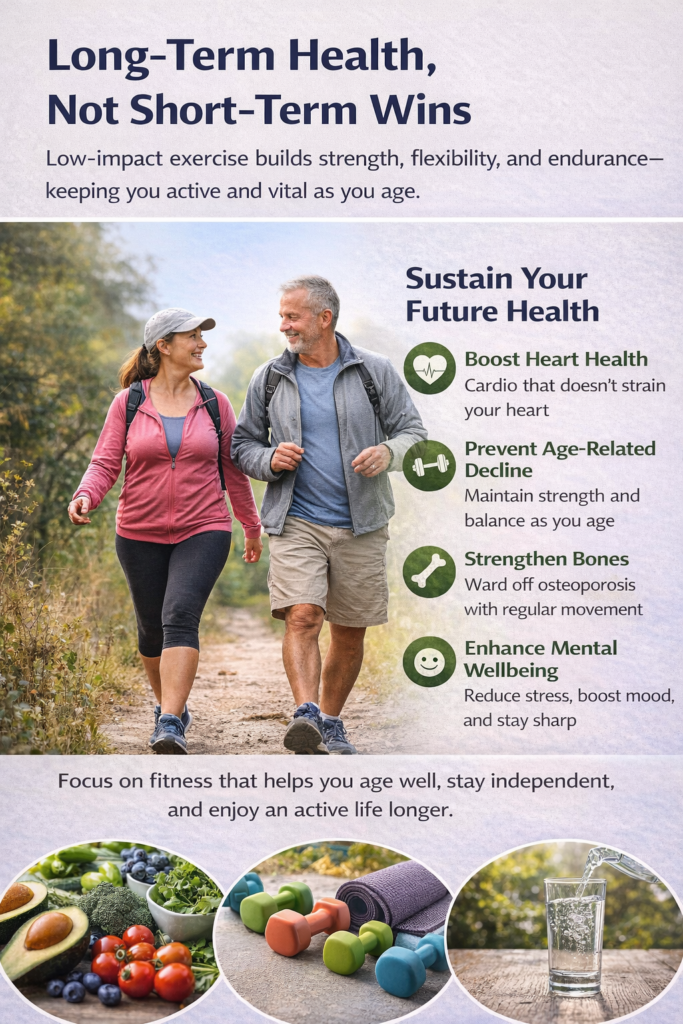
Long-Term Health, Not Short-Term Wins 🕰️
In your 40s, recovery becomes a skill.
Walk after meals. Hydrate consistently. Get morning sunlight. Do five minutes of mobility instead of ignoring stiffness for weeks.
Parents don’t need six-week transformations. They need bodies that still work years from now.
Fitness That Serves Your Family ❤️
The best fitness plan leaves you more capable, not depleted.
Low-impact fitness for busy parents works because it supports real life instead of competing with it.
Parent FAQ (Rank Math Friendly) ❓
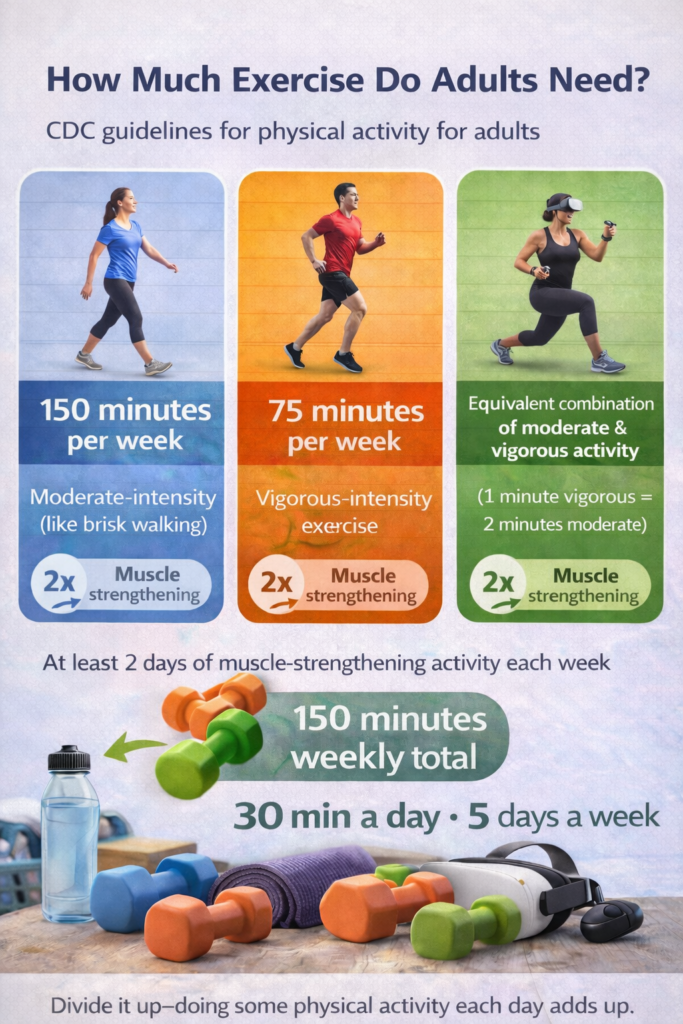
Is low-impact fitness enough after 40? Yes. Consistent moderate activity improves strength, endurance, and longevity.
How often should parents work out? Most parents thrive with 4–6 short sessions per week.
Can VR fitness replace the gym? For many parents, yes. Consistency matters more than equipment.
What if I’m always tired? That’s a sign to reduce intensity, not quit movement.
💡 Reader hint: Ten minutes that helps tomorrow beats forty minutes that ruins it.
Parent Notes You Don’t Hear in Fitness Culture (But Should) 🧠📝
If you’re in your late 30s or 40s and raising kids, there are realities most fitness advice never touches. Not because they’re rare, but because they don’t sell well.
Here’s the first one: your capacity is already being spent all day. Decision-making, emotional regulation, logistics, work pressure, finances, relationship management, and constant vigilance all tax the same system that workouts rely on. When a fitness plan ignores that, it feels like one more demand instead of support.
Another quiet truth is that soreness now has a cost. It’s not just discomfort. It affects sleep quality, mood, patience, and how you move the next day. A workout that leaves you stiff and irritable doesn’t exist in isolation. It leaks into parenting.
📝 Parent note: Feeling better tomorrow is a more important metric than feeling crushed today.
There’s also the identity shift nobody prepares you for. You’re no longer training for something. You’re training to maintain function. That’s not a downgrade. It’s a strategic shift.
Low-impact fitness for busy parents works because it aligns with this reality instead of pretending you’re still living in a low-stress, high-recovery phase of life.
Real-Life Scenarios That Make or Break Consistency 🧩
The After-Bedtime Crash
You finally get the kids down. The house is quiet. This was supposed to be “your time.” But instead of energy, you feel empty. Your body wants rest, not reps.
This is where all-or-nothing thinking kills momentum. If your only definition of a workout is 45 minutes of intensity, you’ll skip it entirely. If your definition includes a 10-minute walk, gentle mobility, or a short VR session, consistency survives.
The Weekend That Went Off the Rails
Weekends are supposed to be flexible, but for parents they’re often more chaotic than weekdays. Sports, family events, errands, unexpected problems.
Missing planned workouts on weekends doesn’t mean you failed. It means your plan didn’t adapt. Low-impact fitness for busy parents allows movement to happen inside those days instead of being canceled by them.
The Minor Injury Spiral
A small knee tweak. A tight back. Foot pain that creeps in slowly. This is where many parents quit entirely because they don’t know how to adjust without stopping.
Low-impact movement gives you options. Walk instead of run. Mobility instead of load. Short sessions instead of long ones. Progress continues without digging a deeper hole.
Considerations That Matter More After 40 🕰️
By your 40s, your body is still capable, but it’s less forgiving.
Recovery debt accumulates faster. Poor sleep compounds more quickly. Stress hits harder. That doesn’t mean you’re fragile. It means inputs matter more.
Joint health becomes a long game. Tendons and connective tissue adapt more slowly than muscle. Sudden spikes in intensity are more likely to cause setbacks than breakthroughs.
This is why low-impact fitness for busy parents emphasizes:
Gradual progressions
Repeatable movement patterns
Moderate intensity
Recovery built into the week
📌 40s insight: Consistency now is less about grit and more about restraint.
What to Prioritize (And What to Stop Worrying About) 🎯
Prioritize These
Walking as a baseline habit
Strength that supports joints and posture
Movement that lowers stress
Sessions that fit your actual life
Stop Obsessing Over These
Perfect programming
Missed workouts
Extreme soreness
Doing what you used to do at 25
Low-impact fitness for busy parents succeeds because it removes unnecessary pressure. When pressure drops, consistency rises.
A Longer-Term View Parents Rarely Take 🧠
Your kids aren’t watching your workout intensity. They’re watching your relationship with movement.
They notice whether you move with pain or confidence. Whether you treat your body like an enemy or a tool. Whether exercise makes you calmer or more irritable.
Low-impact fitness models sustainability. It teaches that movement is something you return to, not something you burn out on.
That’s a legacy worth passing down.
When to Push and When to Pull Back ⚖️
There are days when pushing makes sense. When sleep was decent. Stress is manageable. Your body feels ready.
There are also days when pulling back is the smart choice.
Here’s a simple filter:
If movement improves your mood and energy afterward, you chose well.
If movement worsens sleep, irritability, or pain, adjust next time.
This isn’t weakness. It’s feedback.
Final Takeout for Busy Parents ❤️
You don’t need more discipline. You need a system that respects your life.
Low-impact fitness for busy parents works because it fits between responsibilities instead of fighting them. It protects joints, manages stress, and keeps you functional over the long haul.
That’s not settling. That’s playing the long game.
How Low-Impact Fitness for Busy Parents Builds Real Momentum 💥
One of the biggest advantages of low-impact fitness for busy parents is how quickly it restores momentum instead of draining it. When movement feels achievable, parents are far more likely to repeat it. Repetition is where progress actually comes from, especially for exercise for stressed parents who are already juggling mental overload.
Momentum matters because parenting rarely gives you a clean slate. You’re carrying yesterday’s stress into today. Low-impact fitness works with that reality. A walk after dinner, a short strength session, or a family-friendly routine done at home builds continuity instead of starting from scratch each week.
This is also where family-friendly fitness routines shine. When kids see movement as normal, not extreme or exhausting, they’re more likely to join in or at least respect the time you set aside. That reduces guilt and resistance, two of the biggest silent killers of consistency.
Parents who integrate VR fitness for parents into this mix often find it fills the gap on high-stress days. When weather, time, or energy are limited, VR removes friction and keeps the habit alive without demanding perfection.
💡 Momentum reminder: Consistency beats intensity every single time, especially for parents over 40.
Helpful Internal Resources for Parents 📎
If you want to grow this approach into everyday life, these related guides on Lifetime Family Journey have practical, parent-focused movement ideas.
Each of these supports the same goal: sustainable health that fits real family life.
Closing Perspective for Parents in the Middle of Life 🧠
By midlife, health is no longer about chasing extremes. It’s about protecting energy, preserving joints, and staying present for your family. Low-impact fitness for busy parents supports all three by respecting limits instead of fighting them.
If you’re a parent over 40, stressed, short on time, and tired of plans that collapse, this approach isn’t a compromise. It’s a smarter strategy.
You don’t need to do more. You need to do what lasts.
Bryan States is an Air Force veteran, public health and education master's graduate, and father of six who writes about family systems, resilience, health, and navigating complex life challenges with clarity and structure. With a background in aviation maintenance, aeronautical science, and interdisciplinary studies focused on public health and education, his work blends real-world experience with evidence-informed insight. After two decades of marriage, military service, and parenting under pressure, Bryan focuses on practical strategies that help families build stability, responsibility, and long-term resilience in a noisy, high-stress world.
Supplement stack for healing changed everything when traditional medicine failed me. After bouncing between specialists like a pinball for over a decade, collecting prescriptions like Pokemon cards, I finally took matters into my own hands. What I discovered wasn’t some miracle cure or trendy detox — it was a systematic, science-based approach using targeted supplements…
Ever wondered if music and workout performance are more connected than you realize? You’re crushing it in the weight room when suddenly your favorite metal anthem drops, and boom—you’re pulling PRs you never thought possible. Meanwhile, your gym buddy listening to ambient sounds barely finishes their planned sets. Is this just coincidence, or does science…
The post presents a comprehensive, science-backed full-body workout regimen using progressive overload and multi-joint movements. The exercises discussed include squats, bench press, deadlifts, shoulder press, and bent-over rows, each targeting different muscle groups. Importance is stressed on consulting a fitness professional before undertaking any new exercise program. Various scientific research references are provided for further information.
Let me share something that might shock you. Last month, I was at my daughter’s soccer game when the ref suddenly collapsed on the field. Heart attack at 42 years old. While the paramedics worked on him, I watched parents frantically googling “heart attack symptoms” on their phones. That moment made me realize something crucial:…
The human body is an incredible machine, and nowhere is this more evident than when I watch my six kids running around the backyard. One minute they’re climbing trees, the next they’re doing cartwheels on the trampoline. What amazes me most is how their bodies handle all this activity without falling apart. Understanding skeletal system…
Weight loss requires a holistic approach involving nutrition, exercise, supplements, and occasionally medication. Nutrition should focus on macronutrients, micronutrients, portion control, and hydration. Exercise should incorporate cardio, strength training, flexibility, and consistency. Supplements such as protein powder, fiber, and green tea extract can aid the process. Newer medications like GLP-1 receptor agonists are also available. Monitoring progress and addressing plateaus are crucial for success.