Family Routines That Work: Why Most Fail and What Sticks
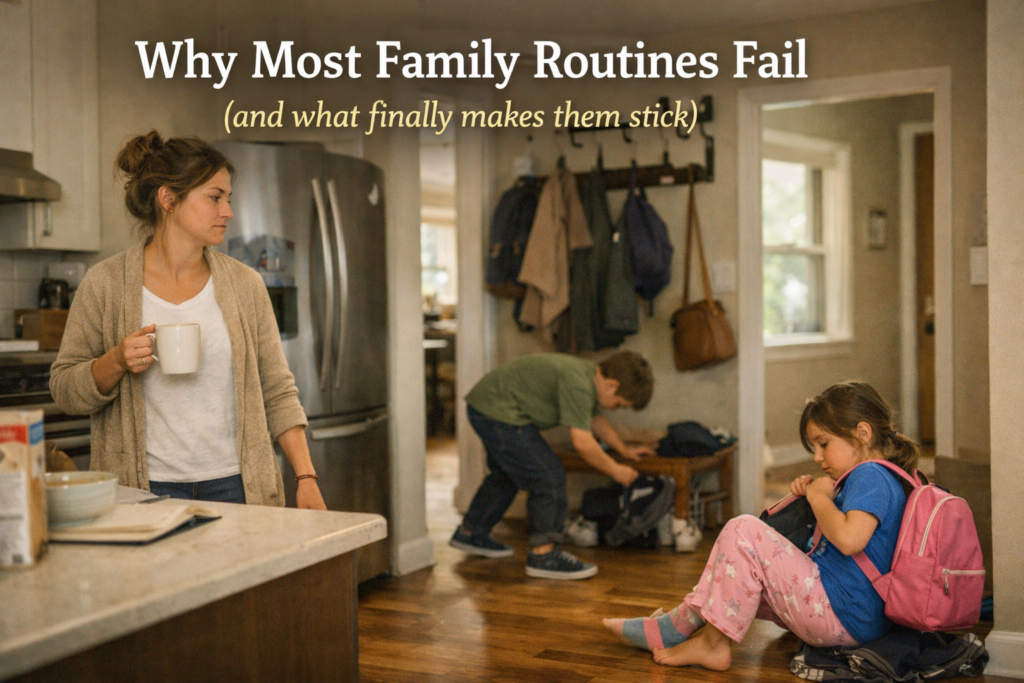
I created a family chore chart once. Color-coded by kid. Laminated. Magnetic. It had rotating responsibilities, star stickers for completion, and a reward tier system I’d sketched out on graph paper like I was designing a video game achievement tree.
It worked beautifully for nine days.
On day ten, someone had soccer practice during dinner prep. On day eleven, I forgot to buy the stickers. By day twelve, the chart was buried under permission slips and grocery receipts, and we were back to yelling “whose turn is it to feed the dog?” from three rooms away.
That chart is still in a drawer somewhere. I see it every time I look for batteries.
📌 Quick Reality Check “If routines worked the way Pinterest promised, January would fix everything.”
Here’s what I’ve learned after years of trying to build systems that survive contact with actual children: most family routines fail because parents lack discipline. They fail because they’re designed for families that don’t exist.
The version of our family that wakes up cheerful, eats breakfast together without negotiation, and transitions smoothly between activities? That family lives in my head. The real version has someone who refuses pants, someone who can’t find their left shoe, and someone who just remembered they need poster board for a project due today.
This isn’t about lowering standards. It’s about building family routines that work in the reality where kids get sick, parents get tired, and life doesn’t pause just because you finally figured out a system.
I’m not a parenting expert. I’m a parent who has watched beautifully planned daily family schedules collapse under the weight of a single Monday morning. What I’m sharing here comes from trial, error, and the hard-won understanding that the best routine isn’t the most impressive one—it’s the one that still functions when everything else goes sideways.
Why Most Parenting Routines Fail
Most advice about family routines assumes you’re starting from a stable baseline. Wake up at the same time. Follow the checklist. Maintain consistency. But that advice skips over why routines fall apart in the first place, and it’s rarely about willpower.
🎯 Routines Built for Ideal Days
When I plan a routine, I do it at night. The kids are asleep. The house is quiet. I have a cup of coffee and a clear mind. In that moment, a 45-minute morning routine that includes a hot breakfast, hygiene tasks, and calm conversation feels entirely reasonable.
The problem is I’m not planning for reality. I’m planning for the best-case version of tomorrow—the one where everyone slept well, no one woke up in a bad mood, and I didn’t stay up too late scrolling through home improvement videos I’ll never act on.
This is optimism bias, and it’s brutal in family planning. We design systems for perfect conditions, then blame ourselves when normal chaos breaks them. A routine that requires everyone to be rested, cooperative, and on time isn’t actually a routine. It’s a wish list.
The first routine I ever built that lasted more than two weeks was the one I designed after three consecutive terrible mornings. I didn’t plan it while hopeful. I planned it while tired, frustrated, and unwilling to pretend tomorrow would be magically different. That’s when I started building for actual conditions instead of ideal ones.
⚡ The Energy Mismatch Problem
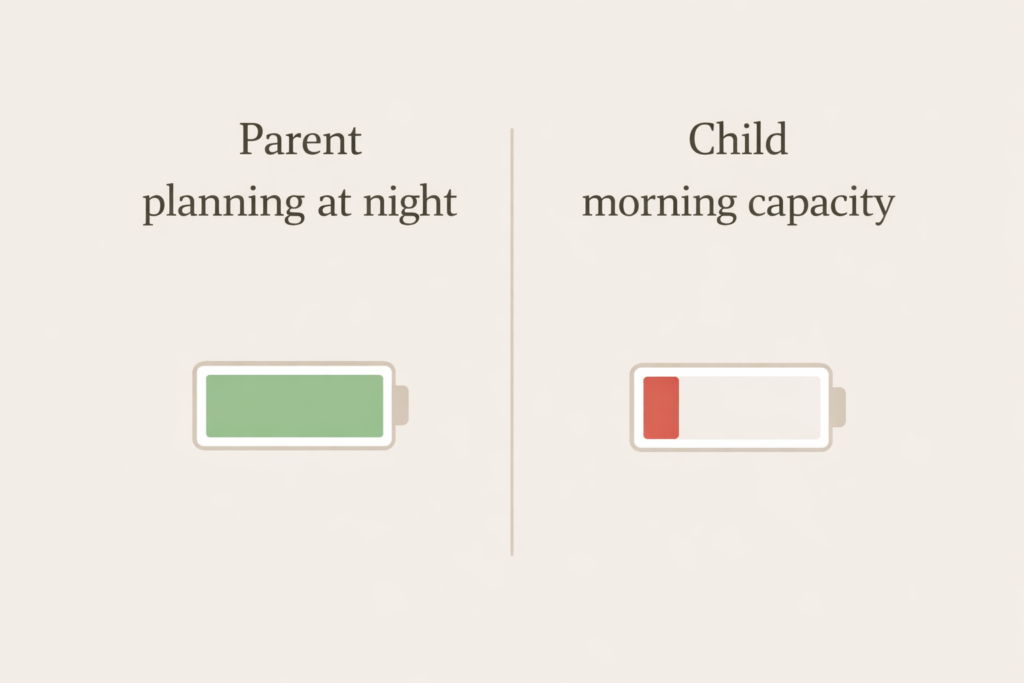
Adults plan routines when we’re calm and thinking clearly. Kids live them when they’re hungry, half-awake, or overstimulated from the day. That gap—between the energy state we’re in when we plan and the energy state we’re in when we execute—is where most routines die.
I used to wonder why my kids could handle a detailed checklist at 3 p.m. but completely fall apart trying to follow the same steps at 7 a.m. It’s not defiance. It’s capacity. Executive function—the brain’s ability to plan, focus, and switch between tasks—fluctuates throughout the day, and it’s lowest when kids are tired or stressed.
So when I plan a morning routine that requires a six-year-old to remember five steps in sequence before breakfast, I’m asking them to perform a cognitive task their brain literally isn’t ready for yet. That’s not a discipline problem. That’s a design problem.
Morning Capacity vs Evening Planning Reality
Parent Planning Energy (9 PM):  ████████████████ 100%
Child Morning Execution (7 AM):  ████░░░░░░░░░░░░  25%

Parent Evening Task Design:     12 steps
Child Morning Actual Capacity:   3–4 steps
The mismatch isn’t about effort. It’s about developmental readiness and circadian rhythm. Adults do our best thinking in the evening. Kids do theirs mid-morning or afternoon. We’re building routines in our peak state for their lowest state, then wondering why it doesn’t work.
⚠️ Critical Understanding Discipline doesn’t fail. Capacity does.
Once I started designing routines with this gap in mind—fewer steps, simpler language, less cognitive load before breakfast—things started sticking. Not because my kids suddenly became more obedient, but because I stopped asking them to do things their brains weren’t wired to handle at that hour.
What Makes Family Routines That Work Different
Every routine that’s lasted more than a month in our home has one thing in common: it doesn’t try to control everything. It focuses on the absolute minimum that has to happen, then lets everything else be flexible.
I call this the Minimum Viable Routine (MVR). It’s the stripped-down version of your day that keeps the house functional even when nothing else goes right.
For us, the MVR is three things: morning hygiene, one meal together, and bedtime. That’s it. Everything else—chores, homework time, screen limits—can shift, slide, or disappear entirely on a rough day, and we’re still okay.
This isn’t about lowering standards. It’s about understanding the difference between what’s essential and what’s decorative. A routine that depends on perfect execution of fifteen tasks isn’t resilient. It’s fragile. One missed step and the whole thing collapses.
But a routine built around three anchor points? That can survive a sick kid, a work deadline, a busted water heater, or all three at once.
⚓ Anchor Points vs Decorative Tasks
Not all parts of your routine carry the same weight. Some tasks are structural—they hold the day together. Others are nice when they happen but aren’t load-bearing.
The mistake I made early on was treating everything like an anchor. I thought if kids didn’t make their beds, put away breakfast dishes, complete their reading log, and organize their backpacks every single morning, the whole routine would fall apart.
It didn’t. What fell apart was my patience trying to enforce tasks that didn’t actually matter to daily function.
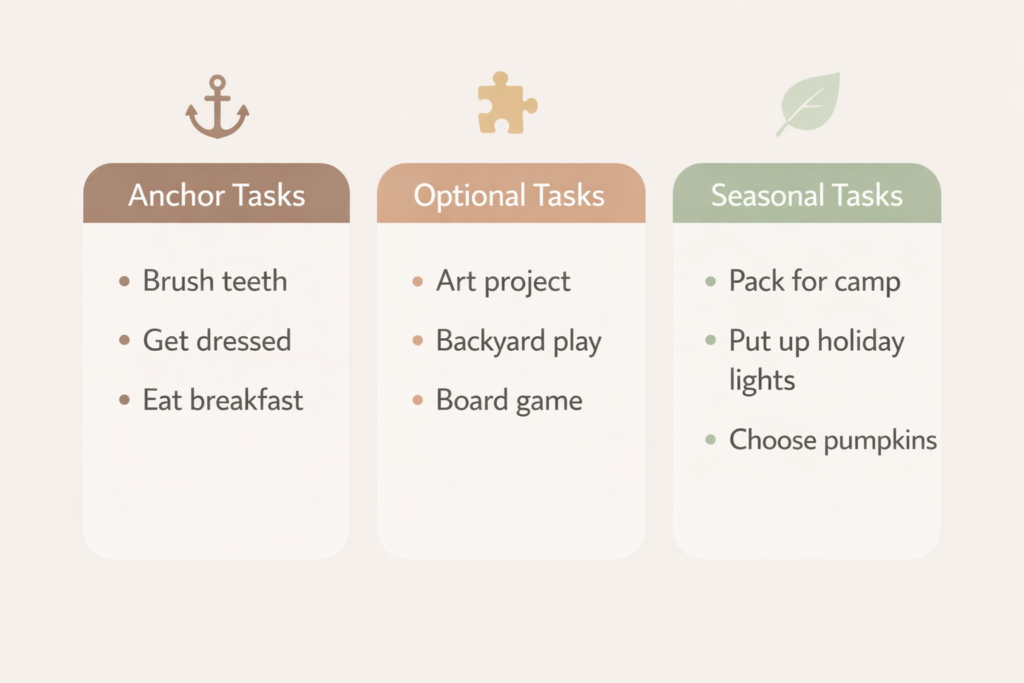
Routine Task Priority
| 🔒 Anchor Tasks (non-negotiable) | 🔄 Optional Tasks (flex when needed) | 📅 Seasonal Tasks (add/drop as life changes) |
|---|---|---|
| Wake-up hygiene | Making beds | School supply prep |
| Breakfast (even if minimal) | Morning chores | After-school activities |
| Bedtime wind-down | Homework at set time | Summer schedule shifts |
| One shared meal | Screen time limits | Holiday rhythm changes |
Anchor tasks are the ones that, if skipped, create downstream problems. If a kid skips brushing teeth, that’s a health issue. If they skip breakfast, focus and behavior suffer. If bedtime gets blown up, tomorrow starts worse.
Optional tasks are things that make life smoother but don’t break anything if they’re missed. A messy bed doesn’t harm anyone. Dishes left in the sink can wait an hour. Homework done at 4 p.m. instead of 3 p.m. doesn’t derail the evening.
Seasonal tasks are the ones that matter intensely for three months, then disappear. Back-to-school prep. Sports practice schedules. Summer camp coordination. These shouldn’t be baked into your permanent routine because they’ll create pressure points when they’re no longer relevant.
Once I separated anchors from decoration, routines became sustainable. I stopped feeling like a failure when optional tasks didn’t happen, because I knew the structure was still intact.
How to Build Routines That Bend Without Breaking
The routines that survive in real families aren’t rigid. They’re resilient. They have built-in space for the fact that life doesn’t follow a script.
Here’s what makes a routine flexible without making it meaningless.
⏰ Flex Windows
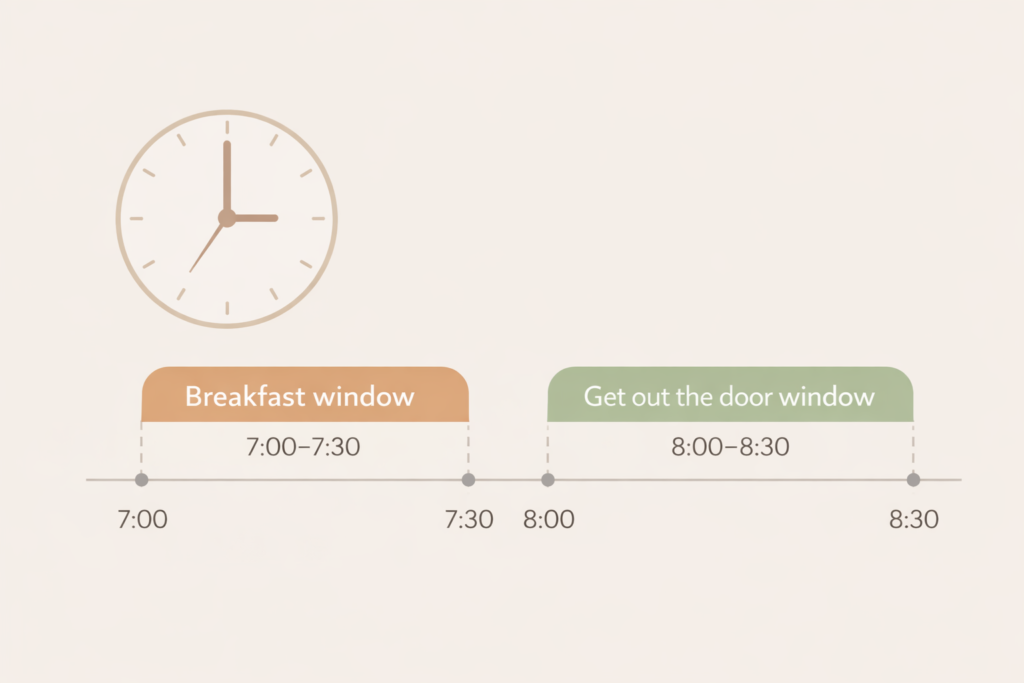
A flex window is a time buffer around a task that allows for normal variability without breaking the routine. Instead of “breakfast at 7:15,” it’s “breakfast between 7:00 and 7:30.” Instead of “bedtime at 8:00,” it’s “in bed by 8:15.”
This sounds like a small change, but it eliminates the biggest source of routine failure: the expectation of precision. Kids aren’t machines. Neither are adults. A routine that depends on everyone hitting exact times will fail the first morning someone can’t find socks.
Flex windows also reduce conflict. When a kid resists getting dressed at 7:10, I’m not fighting to preserve an arbitrary timestamp. I’m just making sure we’re within the window. Consistent structure with built-in flexibility reduces power struggles while maintaining the framework, making daily transitions much easier. That’s a much easier conversation.
🔄 Reset Rituals
A reset ritual is a consistent action you take when a routine gets derailed. It signals to everyone that things went off track, and now we’re recalibrating.
For us, the reset ritual is simple: if the morning falls apart, we regroup at the table. Everyone sits. I ask one question: “What’s one thing we can still do right?” Then we do that thing.
It doesn’t fix the whole morning. But it stops the spiral where one thing goes wrong, then everything else collapses because the routine is already “ruined.”
Reset rituals work because they acknowledge that failure is part of the process. A routine that can’t survive a bad day isn’t a routine—it’s a performance that only works under ideal conditions.
💡 Hard Truth A routine that can’t survive a bad day isn’t a routine. It’s a performance.
🤝 Missed-Day Forgiveness
This is the hardest part for me, and probably for most overwhelmed parents who care enough to build routines in the first place: accepting that routines will be missed, and that’s okay.
I used to think consistency meant perfection. If we skipped the routine once, we’d lost momentum and might as well start over. That mindset guaranteed failure, because life guarantees interruptions.
Now I operate on the two-day rule: if we miss one day, we’re still on track. If we miss two days in a row, we reassess. Is the routine still serving us, or has something changed?
This eliminates the guilt spiral that kills routines. One rough morning doesn’t mean the system failed. It means Tuesday was hard. Wednesday is a new start.
Missed-day forgiveness also teaches kids something important: structure doesn’t require perfection. You can fall off the routine and get back on without drama. That’s a skill they’ll use for the rest of their lives. If you’re constantly feeling behind and need immediate strategies that actually help, the time-saving tips for overwhelmed parents guide offers practical triage approaches that work when everything feels like too much.
When Routines Need to Change (And Parents Miss the Signs)
Routines aren’t static. They work for a season, then stop working, and if you don’t notice the shift, you end up grinding through a system that’s actively making life harder.
I missed the signs once with our bedtime routine. It had worked for years—bath, books, lights out by 8:00. Then suddenly, everything became a battle. Kids resisting the bath. Arguing over book choices. Taking an hour to settle after lights out.
I spent two months trying to enforce the routine harder before I realized the problem wasn’t compliance. The problem was the routine itself had outlived its usefulness. The kids were older. They didn’t need a bath every night. They wanted independent reading time instead of read-alouds. Bedtime at 8:00 wasn’t aligned with their actual sleep needs anymore.
Once I adjusted the routine to match where they were developmentally, the conflict disappeared. Same kids. Different system.
Here are the signs a routine needs to change:
➤ 🚨 Increased resistance without clear cause — If a routine that used to work suddenly doesn’t, something shifted. It might be developmental, social, or schedule-related, but the routine isn’t matching reality anymore.
➤ 😓 You’re working harder to maintain it than it’s worth — Routines should reduce friction, not create it. If you’re spending more energy enforcing the routine than you’re getting back in function, the system is broken.
➤ 📈 Kids outgrow the structure — A routine that worked for a six-year-old won’t work for a twelve-year-old. Developmental changes are real, and routines need to evolve with them.
➤ 📆 External demands change — New school schedules, extracurriculars, work shifts, or family obligations can make an old routine incompatible with current life. Forcing it anyway just creates stress.
➤ 🔥 You’re burned out maintaining it — If keeping the routine alive is exhausting you, it’s not sustainable. A good routine should make life easier for everyone, including the person managing it.
The hardest part of changing a routine is admitting the old one isn’t working. It feels like failure, especially if you invested time building it. But routines are tools, not commitments. If a tool stops serving its purpose, you don’t keep using it out of loyalty. You find a better one.
Conclusion
The routines that stick aren’t the ones that look impressive on paper. They’re the ones that survive Mondays.
They don’t require perfect conditions, flawless execution, or kids who behave like tiny adults. They’re built for real families—the kind where someone always forgets their lunchbox, bedtime negotiations are a daily event, and mornings only work about 70% of the time.
That’s not failure. That’s life.
The difference between a routine that works and one that doesn’t isn’t discipline. It’s design. If you build for ideal conditions, you’ll get a system that collapses the first time reality intervenes. If you build for chaos—for missed steps, rough mornings, and days when everything goes wrong—you’ll get a system that bends without breaking.
Start with your anchors. Protect those. Let everything else flex.
Build in reset points so a bad start doesn’t ruin the whole day.
Forgive the missed days, because they’re inevitable.
And when the routine stops working, don’t force it. Change it.
The goal isn’t perfection. It’s sustainability. A routine that gets followed 70% of the time is infinitely better than one that works beautifully for nine days and then gets abandoned in a drawer with the laminated chore chart.
You don’t need a better system. You need a system that fits the family you actually have. If you’re looking for broader strategies that address the entire day rather than just one transition, building healthy family routines explores how sustainable systems develop over time.
