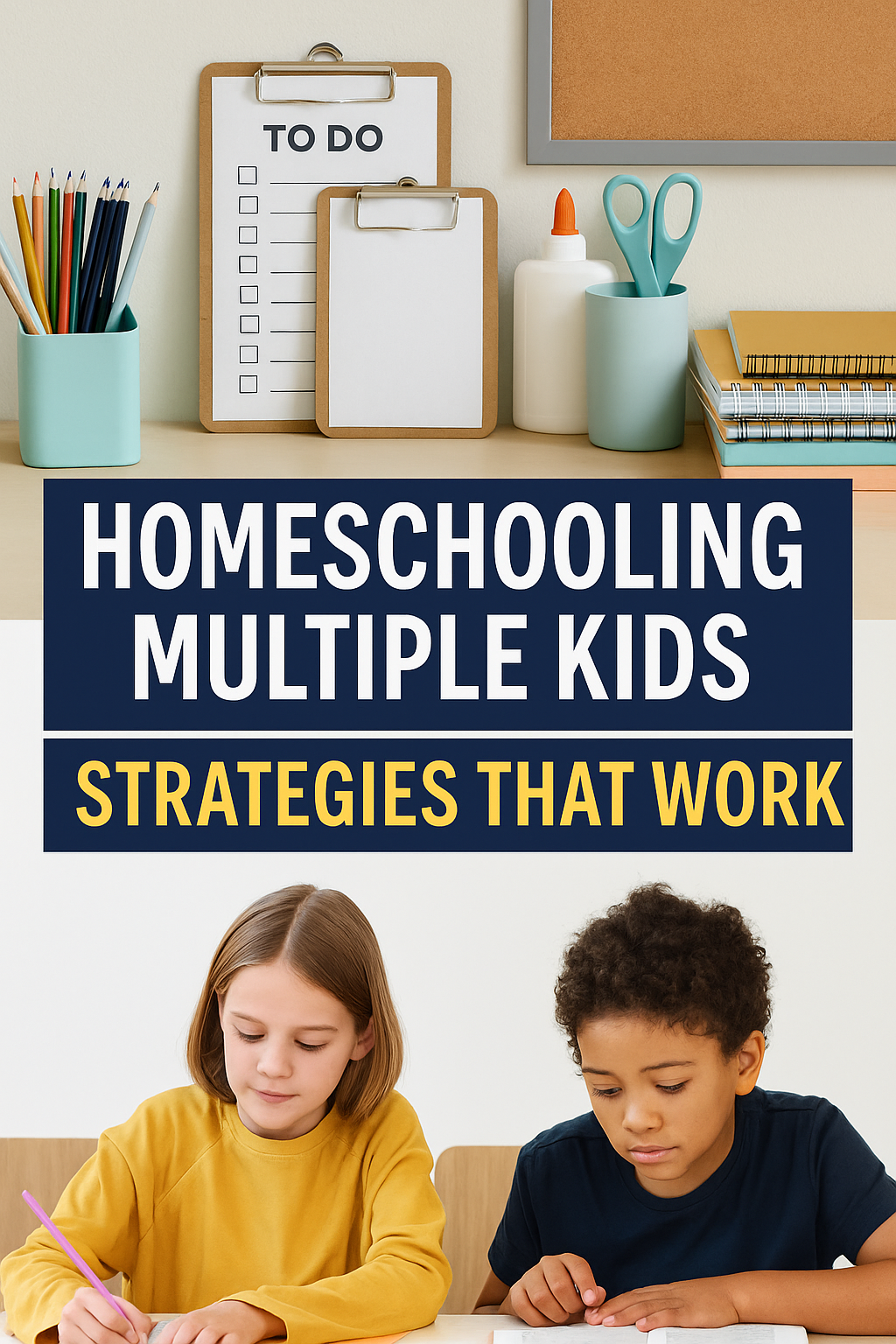
Homeschooling Multiple Kids: Proven Strategies for Success

Let me be honest with you—homeschooling multiple kids feels like trying to conduct an orchestra where half the musicians are playing kazoos, one is having an existential crisis about middle C, and the youngest just discovered that drumsticks make excellent sword fighting tools.
But here’s the thing: after fifteen years of teaching at home, with ages spanning from kindergarten through college, I’ve learned that the chaos isn’t a bug—it’s a feature. The key to success isn’t eliminating the madness—it’s learning to dance with it.
Whether you’re juggling a toddler who thinks crayons are snacks while teaching algebra to your teenager, or trying to explain photosynthesis while someone’s having a meltdown about cursive writing, this guide will help you not just survive, but actually thrive in your multi-child educational adventure.
The Reality Check: What This Journey Really Looks Like
Before we dive into strategies, let’s address the elephant in the room. Social media might show you picture-perfect homeschool moments with children sitting quietly around the kitchen table, but that’s about as realistic as expecting your toddler to fold laundry.
Real life with multiple learners looks more like this: Your eight-year-old is explaining fractions using Goldfish crackers (and eating half the manipulatives), your five-year-old is “helping” by coloring on everyone’s worksheets, and your teenager is rolling their eyes so hard you’re genuinely concerned about permanent damage.
The truth? Some days are going to be disasters. Some lessons will be interrupted by potty emergencies, sibling squabbles, or the neighbor’s dog somehow getting into your backyard. And that’s completely normal.
According to the National Home Education Research Institute, 48% of homeschooling families have three or more children, which means you’re definitely not alone in this beautiful chaos.
⚡ Quick Start (If You’re Overwhelmed Right Now):
Don’t try to implement everything at once. Pick one morning rhythm that works for your family, choose two priority subjects (usually math and reading), and protect one focused teaching block per day. Everything else is bonus. You can add complexity later—right now, you just need something that doesn’t fall apart by 10 AM.
Creating a Flexible Schedule That Actually Works for Everyone
✅ The Foundation: Structure with Breathing Room
Forget those Pinterest-perfect schedules that account for every minute. Real families need routines that can bend without breaking. I learned this the hard way when my rigid 15-minute time blocks crumbled the first time someone spilled orange juice on the math worksheets.
Instead, think in terms of rhythm rather than rigid scheduling. Our mornings always start the same way—breakfast (usually involving negotiations about cereal choices), followed by what we call “morning baskets.” Each child has a basket with books, puzzles, and activities appropriate for their level.
While older students tackle independent reading or work through online coursework, I focus on phonics with the younger ones—this rotation system is essential for teaching multiple children effectively. Then we rotate. The magic happens in the flexibility—if someone’s having a rough day with long division, we might switch to a hands-on science experiment instead.
Morning Rhythm Example:
| ⏰ 7:30-8:30 AM | Breakfast and morning chores |
| 📚 8:30-9:00 AM | Morning basket time (everyone working independently) |
| 🎯 9:00-10:30 AM | Focus time (rotate between children for intensive subjects) |
| 🍎 10:30-11:00 AM | Snack and movement break |
| 👨👩👧👦 11:00 AM-12:00 PM | Group subjects (history, science, read-alouds) |
💡 Loop Scheduling: Your Secret Weapon
This changed everything for our experience. Instead of trying to cram every subject into every day, create a loop of subjects that rotates. Monday might be heavy on math and science, Tuesday focuses on language arts and history, Wednesday brings in arts and life skills.
The beauty of loop scheduling is that if we miss Wednesday’s art lesson because someone had a doctor’s appointment, it just moves to Thursday. No guilt, no stress, no feeling behind.
Just like with building healthy family routines, consistency matters more than perfection. The key is creating systems that serve your family’s unique needs and circumstances.
Building Flexibility Into Your Day:
Create buffer zones between subjects. That fifteen-minute cushion saves your sanity when the inevitable interruption happens. Trust me, interruptions aren’t if—they’re when.
Consider implementing “choice time” where kids can pick from pre-approved educational activities. This gives them agency while keeping learning on track.
Plan for seasonal adjustments. Summer schedules look different than winter ones, and that’s perfectly fine. Embrace the natural rhythms of your family and your environment.
When Everyone Needs You at Once:
This is the moment that breaks most homeschool days. One child is stuck on math, another needs help with reading, and the toddler just discovered the markers. Here’s the solution: triage + timer + rotating blocks. Help whoever has the most urgent need first (usually the youngest, the one melting down, or the one who literally can’t proceed without you), set a timer for 10 minutes, then rotate. Nobody gets endless attention, but everyone gets some. The timer makes it fair and teaches kids that waiting their turn is part of the deal.
Teaching Multiple Age Groups Without Losing Your Mind
🎨 The Art of Subject Integration
This is where home education becomes less like juggling flaming torches and more like conducting a really interesting symphony. The secret to success is finding the natural connections between subjects and age levels.
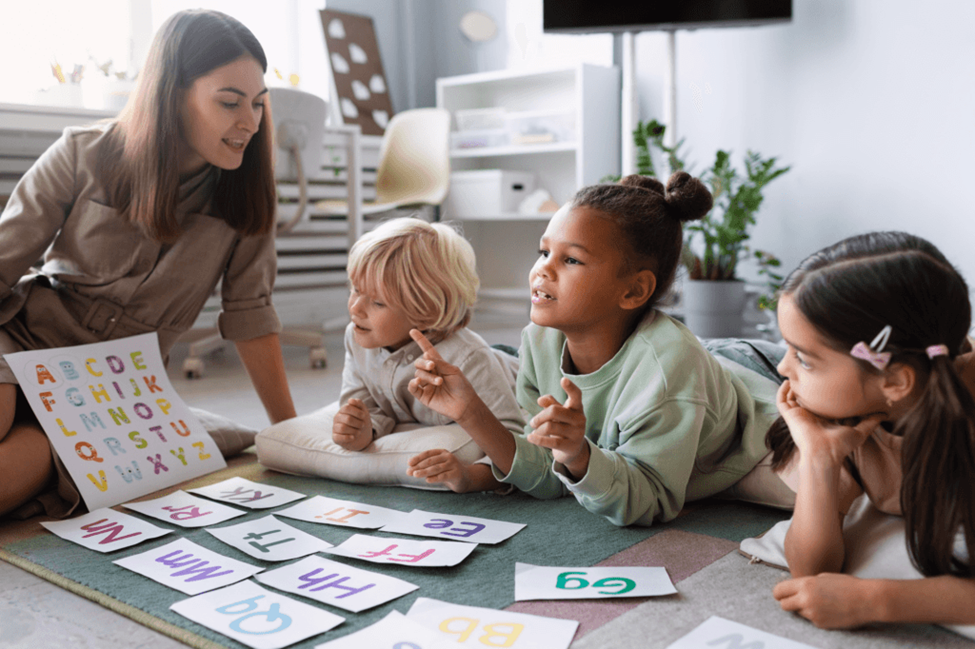
Take ancient history, for example. While a high schooler writes research papers on Roman political systems, a middle schooler creates a timeline of major events, and an elementary-aged child builds Roman structures with blocks. Same topic, different depths, everyone learning together—this approach makes multi-level teaching both manageable and effective.
Literature brings families together beautifully. Reading Charlotte’s Web aloud? Your kindergartner enjoys the story, your third-grader practices reading comprehension, and your sixth-grader explores themes of friendship and sacrifice. Follow up with science lessons about spiders and pigs, geography about farms, and creative writing exercises.
Science experiments work magic for multi-age learning. Everyone can observe a volcano eruption, but older kids record hypotheses and results while younger ones just enjoy the excitement. The key is having different expectations for different ages while keeping the core experience shared.
📌 Subject Combination Success Stories:
📖 History + Literature: Study the American Revolution while reading Johnny Tremain
→ Younger kids: Color maps and timelines
→ Older kids: Analyze cause and effect in written responses
🍪 Math + Cooking: Fractions become real when you’re doubling a cookie recipe
→ Measurement makes sense when you’re seeing cups and tablespoons in action
→ Percentages click when scaling recipes up or down
🚀 Science + Art: Studying the solar system?
→ Create scale models showing planetary distances
→ Paint planetary landscapes with accurate atmospheric colors
→ Write science fiction stories set in researched environments
The Peer Teaching Advantage:
One unexpected benefit of teaching multiple children is the natural peer tutoring that develops. When an older child explains long division to a younger sibling, they’re reinforcing their own understanding while building confidence and sibling bonds.
Set up systems where older kids can safely help younger ones. This doesn’t mean turning your teenager into an unpaid teacher’s aide, but rather creating opportunities for natural mentoring moments that make home education more manageable.
Managing Different Learning Styles and Academic Levels
🧠 Embracing the Beautiful Chaos of Individual Differences
Here’s what no one tells you: each child will learn differently, progress at their own pace, and have completely unique strengths and challenges. A child who devours novels might struggle with basic math facts, while another who can build complex Lego structures might find handwriting absolutely torturous.
| Learning Style | What They Need | Practical Tools |
| 👁️ Visual Learners | Charts, diagrams, colorful presentations | Markers, poster boards, mind maps, color-coding systems |
| 👂 Auditory Learners | Discussion, verbal explanations, sound | Educational podcasts, audiobooks, verbal presentations, talking through concepts |
| 🤸 Kinesthetic Learners | Movement, hands-on activities, touch | Math manipulatives, standing desks, exercise balls, movement breaks |
Research shows that homeschool students score above average on achievement tests regardless of their parents’ level of formal education or their family’s household income, proving that individualized attention works regardless of background.
The One-on-One Magic:
Even with multiple learners, carving out individual time with each child makes an enormous difference. This doesn’t have to be hours—even fifteen minutes of focused attention can address specific struggles or celebrate particular victories.
I schedule these mini-sessions during different parts of the day. While some kids work independently or during quiet time, I can focus intensively on one child’s specific needs. It’s during these moments that real breakthroughs happen.
Understanding different college learning styles has helped me adapt my teaching approach for older students. The same principles that work in higher education can be scaled down for younger learners.
✅ Practical Differentiation Strategies:
✔️ Use leveled readers for the same story
Everyone discusses the plot, but each child reads at their appropriate level
✔️ Provide choice in how children demonstrate learning
Some write reports → others create presentations → others build models or record videos
✔️ Adjust expectations without lowering standards
Example: A child with dyslexia gives oral reports instead of written ones, but content expectations remain high
✔️ Create learning contracts with older children
Allows them to take ownership of their education while providing necessary structure
Keeping Younger Kids Engaged During School Time
🎈 The Art of Strategic Distraction
Let’s talk about the real challenge: keeping toddlers and preschoolers productively occupied while you’re trying to explain algebraic equations to your teenager. This requires the strategic planning of a military operation and the creativity of a preschool teacher.
Busy bags are your lifeline. Rotate through different activities: puzzles, coloring books, stickers, play dough, lacing cards, and simple matching games. The key is novelty—bring out different bags on different days to maintain interest.
Create learning stations around your main teaching area. Set up a play kitchen, a block corner, or an art table where little ones can “work” alongside their older siblings. The goal is parallel play that feels important and grown-up.
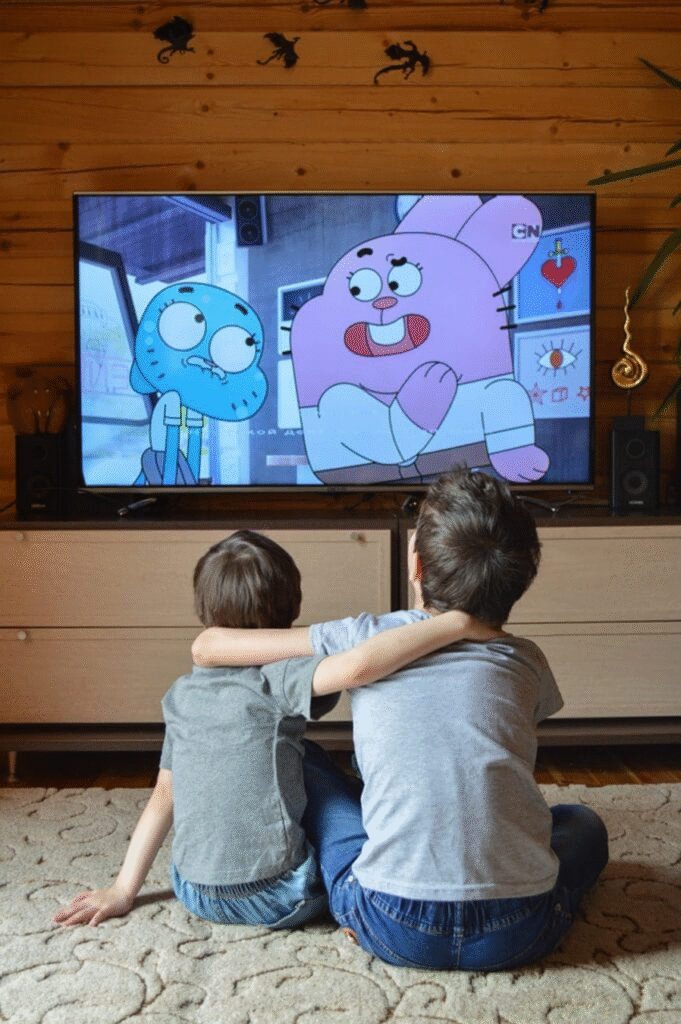
Scheduled screen time isn’t the enemy when used strategically. Twenty minutes of an educational show like Sesame Street or Daniel Tiger can buy you focused time with older children for challenging concepts.
💡 Pro Tips for Younger Child Management:
👉 Give them “important jobs”
→ Pencil sharpener → Paper distributor → Official timer keeper
Little kids love having responsibilities that make them feel grown-up
👉 Create calm atmospheres
→ Audio stories in the background → Quiet music playing
This soothes fussy little ones while providing ambiance for focused work
👉 Plan sensory breaks
→ Playdough time → Quick dance party → Kinetic sand session
A few minutes of sensory input can reset everyone’s energy levels
The Nap Time Advantage:
If you have children who still nap, protect this time fiercely. This is when you tackle the subjects that require intense focus with older children, handle administrative tasks, or simply recharge your own batteries.
For non-nappers, establish “quiet time” where everyone looks at books, listens to audio stories, or engages in calm activities. Even teens benefit from this midday reset.
Dealing with Meltdowns (Including Your Own)

😅 When Everything Falls Apart (And That’s Okay)
Meltdowns happen in home education families. Sometimes it’s the six-year-old who can’t remember 7+5 for the fifteenth time. Sometimes it’s the teenager who’s overwhelmed by essay requirements. And sometimes—let’s be honest—it’s you, standing in the kitchen at 2 PM, wondering if you’re completely ruining your children’s education.
First, breathe. Seriously. Take five deep breaths before you react to any meltdown, including your own. Most crises aren’t actually crises—they’re just overwhelming moments that feel bigger than they are.
Change the scenery when things get heated. Move outside, switch to a different room, or take a walk around the block. Fresh air and new surroundings can reset everyone’s mood remarkably quickly.
Music therapy isn’t just for professionals. When tensions run high, put on upbeat music and have an impromptu dance party. It sounds ridiculous, but moving your body changes your brain chemistry and can shift the entire family’s energy.
🚨 Emergency Reset Strategies:
1️⃣ Call for a “do-over”
Stop whatever is causing stress → Take a 30-minute break → Try again with a completely different approach
2️⃣ Use strategic humor
Make a joke about the situation (not about the child) → Defuse tension → Remind everyone this isn’t life-or-death
3️⃣ Phone a friend
Let the child explain their frustration to grandma or a family friend → Gain outside perspective → Reset emotional state
Managing Your Own Overwhelm:
Remember that bad days don’t equal failure. Even traditional schools have substitutes, snow days, and days when nothing goes according to plan.
Keep a “victory journal” where you write down positive moments and breakthroughs. On tough days, reading past successes reminds you that you’re doing better than you think.
Know when to call it a day. Sometimes the kindest thing you can do for everyone is to close the books, make hot chocolate, and read stories on the couch.
Building Your Support Network
👥 Creating Your Village
Home education can feel isolating, especially during challenging phases. Building a strong support network isn’t luxury—it’s necessity for long-term success and sanity.
Local homeschool groups provide immediate, practical support. Other parents understand the unique challenges you face and can offer everything from curriculum recommendations to emergency childcare during appointments. Don’t wait until you desperately need help to start building these relationships.
Online communities offer 24/7 support and advice from families worldwide. Whether you’re dealing with a specific learning challenge at 10 PM or need encouragement during a particularly difficult week, online support groups provide invaluable resources.
Recent data shows millions of families across the United States have chosen home education, creating a substantial and growing community available for support and connection.
Co-op opportunities can supplement your home instruction while providing social interaction for both children and parents. Consider joining or starting a co-op for subjects that benefit from group instruction—science labs, art classes, foreign languages, or drama productions. This naturally addresses the “socialization question” while giving you a break from teaching subjects outside your comfort zone.
📌 Building Support That Actually Helps:
Find your tribe gradually. Not every family will be a perfect fit for yours, and that’s okay. Look for families who share similar values and approaches to education.
Offer support to others. Being helpful to other families creates reciprocal relationships and strengthens your entire community.
Don’t be afraid to ask for help. Most experienced educators remember their early struggles and are happy to offer guidance and encouragement.
Just like learning how to raise polite children, building community relationships takes time, consistency, and mutual respect.
Professional Support When Needed:
Sometimes you need expert help—tutors for challenging subjects, educational therapists for learning differences, or counselors for family dynamics. Recognizing when professional support would benefit your family is a sign of wisdom, not failure.
Connect with your local school district’s special services if you have children with diagnosed learning differences. Many districts offer services to homeschooled children, including testing, therapy, and specialized instruction.
Academic Excellence: What the Research Shows

📚 The Academic Achievement Reality
One of the biggest concerns parents have is whether their children will achieve academic success. The research is overwhelmingly positive.
According to the National Home Education Research Institute, 78% of peer-reviewed studies on academic achievement show homeschool students perform statistically significantly better than those in institutional schools. This holds true even with varying abilities and interests among children.
Research shows that home-educated students consistently score significantly above public-school students on standardized academic achievement tests, typically performing well above the national average across all subject areas.
What makes home education with multiple children so academically effective? Several factors contribute:
| Success Factor | Why It Works |
| 📝 Individualized instruction | Each child receives attention tailored to their learning style and pace |
| ⚡ Flexible pacing | Children can accelerate in strong subjects and take extra time in challenging areas |
| 🌍 Real-world application | Learning happens in context, making concepts more meaningful and memorable |
| ❤️ Strong family relationships | The close parent-child bond enhances the learning environment and motivation |
Research from the National Center for Education Statistics confirms that the most common reason parents choose home education is concern about school environment, including safety, drugs, and negative peer pressure (80 percent), followed by desire for individualized instruction.
Practical Organization and Management Tips
📚 Systems That Actually Work for Real Families
Organization is crucial when teaching multiple children, but it needs to be sustainable, not perfect. Over-complicated systems fail because real families don’t have time to maintain them.
The Central Command Station: Designate one area as your educational headquarters. This doesn’t need to be a dedicated room—a corner of the kitchen or living room works fine. Keep essential supplies, schedules, and current materials easily accessible.
Individual Learning Spaces: Each child needs their own space for focused work, even if it’s just a portable bin with their materials. This reduces arguments about supplies and helps children take ownership of their learning materials.
Curriculum Storage Solutions:
Use clear, labeled bins for each subject. This makes it easy to grab what you need and helps children find materials independently.
Create a simple checkout system for shared materials like manipulatives, art supplies, or reference books.
Store current materials separately from future materials. Having next year’s curriculum visible can be overwhelming and confusing for everyone.
✅ Record Keeping Made Simple:
Take photos of completed projects and activities. This creates a visual record of learning that’s more meaningful than just test scores.
Use a simple attendance tracking method. A wall calendar with stickers works as well as complicated spreadsheets.
Keep samples of each child’s work throughout the year. This shows progress over time and helps you identify areas that need attention.
Technology Integration:
Use apps and online tools that serve multiple purposes. Khan Academy, for example, provides instruction, practice, and progress tracking for multiple grade levels.
Create shared digital calendars that older children can access independently. This builds responsibility and reduces the number of times you hear “What are we doing today?”
Set up simple digital portfolios where children can store and organize their best work throughout the year.
The Financial Reality of Teaching Multiple Children
💰 Making It Work on Any Budget
One concern many families have about home education is the cost. The good news is that teaching multiple children at home can be incredibly budget-friendly, especially when resources are shared.
Many families report spending significantly less than private school tuition, with costs varying widely based on curriculum choices and teaching approach. With multiple children, shared resources make the per-child investment even more manageable.
Cost-Saving Strategies:
Buy curriculum that can be reused for multiple children. Math programs, science curricula, and literature studies often work for different age levels with modifications.
Take advantage of free resources like library programs, online educational websites, and community activities.
Join co-ops to share costs for specialized classes, field trips, and group activities.
Homeschooling can significantly reduce educational costs for families, especially when materials are reused across multiple children and community resources are leveraged effectively.
Creating Safe Learning Environments
🏠 Safety First, Always
When you’re responsible for multiple children’s education at home, safety becomes paramount. Just like implementing family home security strategies, creating a safe learning environment requires planning and consistency.
Physical Safety Considerations:
Ensure your learning spaces are free from hazards, especially with younger children around. Store sharp tools, chemicals for science experiments, and small manipulatives safely.
Create clear boundaries for different activities. Science experiments happen in designated areas, art projects have specific spaces, and quiet reading occurs in comfortable, well-lit areas.
Establish safety protocols that all children understand. Even your youngest should know basic rules about moving between spaces and handling materials.
Emotional Safety:
Foster an environment where making mistakes is part of learning. Children should feel safe to ask questions, struggle with concepts, and express frustration without fear of judgment.
Address sibling conflicts quickly and fairly. Teaching children how to resolve disputes respectfully contributes to both their social development and the overall learning atmosphere.
Model the behavior you want to see. How you handle your own frustrations and mistakes teaches your children more about emotional regulation than any curriculum ever could.
Celebrating Success and Maintaining Perspective
🎉 Recognizing Victory in the Everyday
Success in home education looks different than traditional school success. You’re not just teaching academic subjects—you’re building family relationships, fostering individual growth, and creating lifelong learners.
Small victories matter enormously. The day your struggling reader finishes their first chapter book, the moment your math-anxious child solves a problem independently, or the afternoon when siblings work together without arguing—these are the moments that matter most.
Document the journey through photos, videos, and written observations. Years from now, you won’t remember the specific math lesson that caused tears, but you will treasure the photo of your children reading together on the couch.
Celebrate learning differences instead of trying to eliminate them. The child who learns through movement isn’t broken—they’re kinesthetic. The child who asks endless questions isn’t difficult—they’re naturally curious. Reframing challenges as unique strengths changes everything.
💡 Creating Family Learning Traditions:
Establish end-of-week celebrations that acknowledge everyone’s efforts and achievements. This might be a special meal, a family movie, or a fun outing.
Create learning adventures that become family stories. The day you turned the living room into ancient Rome, the week you studied local history by visiting historical sites, or the month you learned about weather by tracking local conditions.
Build traditions around learning milestones. First day photos, end-of-year portfolios, or special recognition for overcoming particular challenges help children see their growth over time.
Incorporating family fitness activities into your educational routine creates positive associations with learning while promoting physical health.
When You Feel Like You’re Failing
Remember that education is a marathon, not a sprint. Days that feel like failures are just single steps in a much longer journey.
Focus on character development alongside academic achievement. The child who learns to work independently, help younger siblings, and persist through challenges is receiving an education that extends far beyond textbooks.
Trust the process and trust yourself. You know your children better than any outside expert. Your love, attention, and dedication are providing them with something truly special.
The research confirms this long-term success. Many studies have found positive long-term outcomes for homeschool graduates, including strong performance in college and beyond, demonstrating that the investment pays dividends for years to come.
Frequently Asked Questions
Do I need to homeschool each kid separately?
No. Most subjects can be taught together with age-appropriate adjustments. Use the same core content—history, science, read-alouds—and differentiate the follow-up work. A high schooler writes an essay while a third-grader draws a picture about the same topic. Save one-on-one time for skills that truly need individual attention like early reading or advanced math.
How do I handle a kid who refuses to do the work?
First, figure out why. Is the work too hard? Too easy? Is the child tired, hungry, or dealing with something emotional? Refusal is usually a symptom, not the problem. Address the root cause—adjust difficulty, take a break, try a different approach, or table it and come back tomorrow. Power struggles rarely improve learning.
What if my older child is behind grade level?
Grade level is a rough guideline, not a verdict. Work at your child’s actual level, not their “should be” level. Focus on consistent progress, not arbitrary timelines. Many homeschooled kids work below, at, and above “grade level” simultaneously in different subjects—and that’s completely normal and healthy. Teach the child in front of you.
How do I balance household responsibilities with teaching?
You don’t balance them—you integrate them. Kids can do laundry, cook, clean, and manage household tasks as part of their education. Life skills are education. A child who can plan a meal, manage a budget, and do their own laundry is learning valuable content that many “grade-level” students never master.
What curriculum should I use for multiple ages?
Start with what you can teach together—history, science, character development, read-alouds. Use separate curriculum only for skills that must be individualized: math, writing, and early reading. Don’t buy five complete curriculum sets. Share resources, reuse materials, and focus on learning, not matching your house to a catalog.
How do I know if I’m doing enough?
Are your kids learning? Are they asking questions? Can they apply what they’ve learned? Then you’re doing enough. “Enough” doesn’t mean replicating school at home—it means facilitating growth. If you’re seeing progress over months (not days), you’re on track. Trust the process and stop comparing your inside reality to everyone else’s highlight reel.
Final Thoughts on This Journey
Teaching multiple children at home isn’t just an educational choice—it’s a lifestyle that transforms your entire family dynamic. Yes, there will be days when you question everything, moments when the chaos feels overwhelming, and times when you wonder if you’re doing enough.
But remember this: every family’s journey looks different, and that’s exactly how it should be. The beauty lies not in perfection, but in the authentic relationships you’re building, the individual growth you’re fostering, and the love of learning you’re cultivating in each unique child.
Trust yourself, embrace the mess, celebrate the victories (no matter how small), and remember that you’re giving your children something precious—your time, attention, and the freedom to learn at their own pace in an environment filled with love.