Parental Burnout: The Dangerous Exhaustion Parents Ignore

I fold the last load of laundry at 10 PM, scroll through tomorrow’s schedule on my phone, and feel nothing. Not anger. Not satisfaction. Just a flat, colorless awareness that I’ll do it all again tomorrow. The house is quiet. The kids are asleep. Everything that needed to happen today happened. And yet I can’t remember the last time I felt genuinely rested.
This is what parental burnout looks like for most of us—not a dramatic collapse, but a slow erosion of energy that never quite replenishes. We don’t call out sick. We don’t skip responsibilities. We show up, we function, we get things done. But somewhere beneath the competence, something fundamental has worn thin.
The cultural narrative around burnout expects visible failure. We imagine someone who can’t get out of bed, who breaks down crying in the grocery store, who finally hits a wall and stops functioning. But for many parents, burnout doesn’t announce itself with crisis. It settles in as a quiet companion—a persistent exhaustion that coexists with productivity, a numbness that shows up even on good days.
I’ve noticed this pattern in myself and in countless conversations with other parents: we’re tired in a way that sleep doesn’t fix. We’re overwhelmed in a way that doesn’t match our actual schedules. We feel behind even when we’re caught up. And because we’re still managing, still performing all the expected tasks, we don’t give ourselves permission to acknowledge what’s actually happening.
The problem isn’t that we’re weak or ungrateful. The problem is that parenting demands a level of sustained mental and emotional labor that no human system was designed to carry indefinitely without genuine recovery. And we’ve normalized this depletion to the point where we only recognize burnout when it becomes catastrophic.
📌 Quiet Burnout
Functioning isn’t the same as being well.
Why Most Parents Don’t Recognize Burnout in Themselves
We miss our own burnout because we’re using the wrong measuring stick. We compare ourselves to crisis scenarios—parents dealing with serious illness, single parents working multiple jobs, families in genuine emergency. Against those backdrops, our steady exhaustion feels unremarkable, even illegitimate.
This comparison doesn’t protect us. It just delays recognition until the problem deepens.
The “Others Have It Worse” Trap
I’ve caught myself doing this calculation dozens of times: my kids are healthy, my partner helps, we have enough money, I have support. By every external metric, I should be fine. And because I should be fine, I interpret my exhaustion as personal failure rather than systemic overload.
Gratitude becomes a silencer. We acknowledge our privileges—and we should—but then we use those privileges to dismiss our own experience. The logic goes: if others can handle more with less, then my tiredness must be a character flaw.
But exhaustion doesn’t work on a relative scale. Your nervous system doesn’t care that someone else is managing a harder situation. It only knows whether your current load exceeds your current capacity for sustained attention, decision-making, and emotional regulation. When that balance tips for long enough, burnout happens regardless of how your situation compares to anyone else’s.
Productivity Masks Exhaustion

The most insidious thing about quiet parental burnout is that it coexists with competence. Tasks still get done. Meals appear. Appointments happen. Kids get to school. From the outside, everything looks fine.
We interpret this productivity as evidence that we’re not really burned out. After all, if we were truly exhausted, wouldn’t we be failing at things? Wouldn’t there be visible consequences?
But task completion isn’t a measure of wellbeing. It’s entirely possible to execute your responsibilities while running on empty, to perform every expected action while feeling nothing, to check every box while your internal reserves drain away.
I’ve had weeks where I accomplished everything on my list and felt worse at the end than at the beginning. The doing didn’t restore me. It just confirmed that I could keep doing—which meant I would keep doing, indefinitely, until something else changed.
Parenting Has No Clear Off Switch
When you finish a work project, it’s done. When you complete a home repair, it stays fixed. But parenting operates on a completely different timeline. The work never concludes. The needs never stop arising. The mental tracking never gets to fully power down.
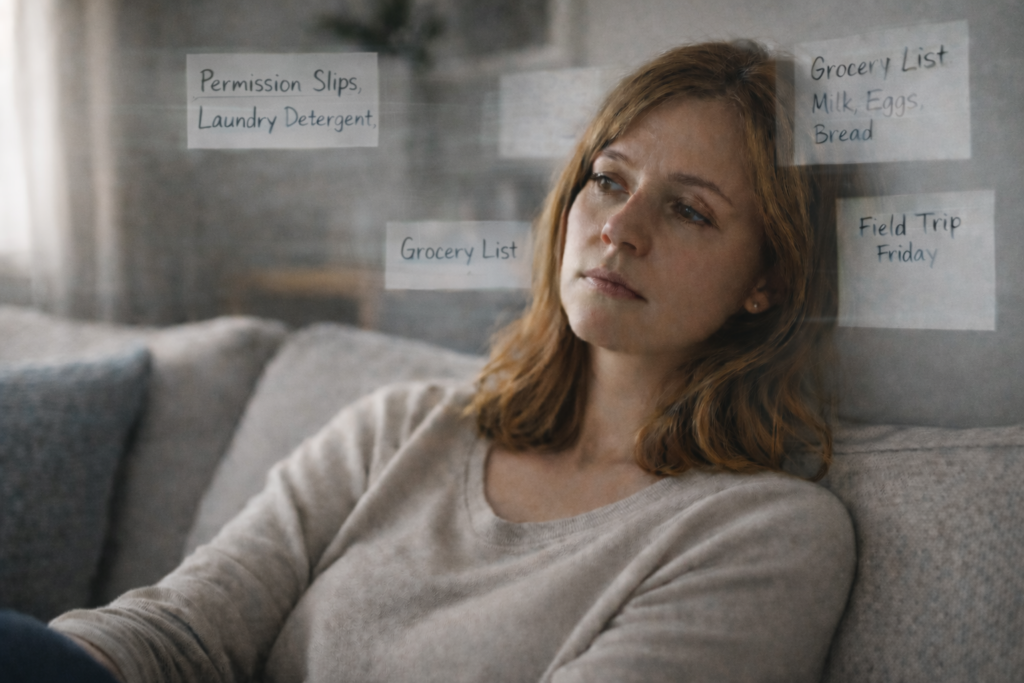
Even during moments of rest, my brain is still running background processes: calculating how many days until we need more milk, noting that the younger one seems congested, remembering that permission slip is due Friday, tracking whether the moody teenager actually ate lunch. This ambient monitoring doesn’t feel like work because it’s not producing anything visible, but it consumes cognitive resources constantly.
The absence of clear boundaries means there’s no built-in recovery window. Unlike jobs with defined hours or projects with completion dates, parenting just continues. And our systems aren’t built to sustain that kind of open-ended responsibility without genuine breaks—not 20-minute breaks where we’re still mentally on call, but actual periods where someone else holds the full weight and we get to mentally disengage.
Most of us never get that. So we adapt by lowering our baseline, by normalizing a state of constant partial depletion, by learning to function while depleted. Which works, until it doesn’t.
The Mental Load That Never Turns Off
There’s a specific kind of exhaustion that comes from holding too much in your head for too long. Not the physical tiredness of a hard workout or a sleepless night, but a cognitive weariness that accumulates from managing an endless stream of small, interconnected details that never resolve.
This is what researchers and parents have started calling the mental load—and it’s one of the primary drivers of quiet burnout that almost no one talks about directly.
What Mental Load Actually Is
Mental load is the invisible work of running a household and raising children: the remembering, the anticipating, the planning, the tracking, the coordinating. It’s knowing when the kids need new shoes because you’ve been watching their growth patterns. It’s holding everyone’s schedules in your head and cross-referencing them before making plans. It’s noticing when you’re running low on toilet paper before you actually run out.
It’s the gap between execution and management. Anyone can make dinner once you tell them what to make and confirm the ingredients are available. But someone has to notice that dinnertime is approaching, assess what needs to happen, check what’s in the fridge, remember dietary restrictions and preferences, decide what to make, and potentially add missing ingredients to a shopping list for later.
That someone, in most households, defaults to the same person. And that cognitive labor—that constant background processing—depletes mental resources even when no physical action occurs.
I can sit still on the couch and still be working, because my brain is running through tomorrow’s schedule, next week’s appointments, the ongoing tracking of who needs what and when. The external world sees rest. My nervous system experiences continued demand.
Why It’s So Draining
Our brains have limited bandwidth for active decision-making and future planning. Every decision, no matter how small, uses some of that capacity. And parenting involves hundreds of micro-decisions daily: what to pack for lunch, whether to push the bedtime routine or let it slide, how to respond to the school email, whether this behavior needs addressing now or can wait.
Each individual decision feels trivial. Cumulatively, they create what researchers call decision fatigue—a state where your capacity for good judgment diminishes because you’ve already spent too much mental energy on previous choices.
Add to this the constant vigilance required by parenting. You’re always partly listening for a problem, partly scanning for needs, partly anticipating what might go wrong. Even when things are going well, you can’t fully power down the monitoring system. Your attention is never entirely your own.
This combination—endless small decisions plus constant background vigilance—creates a particular kind of cognitive depletion that doesn’t match any external crisis. You’re not dealing with anything dramatic. You’re just holding too much, for too long, without genuine relief.
📊 Visible Tasks vs. Invisible Load
| What Others See | What You’re Actually Holding |
|---|---|
| Making dinner | → Meal planning, inventory tracking, dietary needs, timing coordination |
| Answering a question | → Context from three previous conversations, emotional state assessment, future implications |
| Driving to practice | → Schedule management, equipment tracking, sibling coordination, route planning |
| Buying school supplies | → List monitoring, budget tracking, need anticipation, comparison shopping |
The invisible load doesn’t show up on your calendar. It doesn’t leave physical evidence. But it consumes mental resources just as surely as any visible task—and because it’s invisible, it rarely gets acknowledged or redistributed.
Understanding decision fatigue and cognitive load can help contextualize this exhaustion. The American Psychological Association discusses how ongoing decision-making depletes mental resources, creating the conditions for burnout even when individual tasks seem manageable.
Why “Self-Care” Advice Misses the Point
I’ve lost count of how many times someone has suggested I “take time for myself” when I mention feeling depleted. The advice always means well. And technically, it’s not wrong—rest matters, personal time matters, doing things you enjoy matters.
But suggesting self-care as the solution to parental burnout is like suggesting someone drink more water while they’re bailing out a sinking boat. It might help marginally, but it doesn’t address the fundamental problem: the boat is taking on water faster than any individual can bail.
Self-Care Without System Change

A bath doesn’t reduce the mental load. It just postpones your re-engagement with it. A yoga class doesn’t change how many decisions you’re responsible for tomorrow. A night out doesn’t redistribute the invisible labor that will be waiting when you get home.
These activities might provide temporary relief, a brief window where you’re not actively managing everything. But they exist within a system that remains unchanged. You return from your “self-care” to the exact same conditions that created the depletion in the first place.
I’ve taken plenty of breaks that didn’t actually help. I’ve had evenings to myself that I spent mentally running through everything I needed to handle the next day. I’ve gone on vacations where I spent the whole time coordinating logistics for everyone else. The problem wasn’t that I failed to relax properly. The problem was that the underlying structure—the allocation of responsibility, the distribution of mental load, the expectation that I would continue managing everything—never changed.
When the system itself is the source of depletion, adding activities to an already-full schedule doesn’t create relief. It just adds more things to manage.
Recovery Requires Reduction, Not Addition
Real recovery from quiet burnout doesn’t come from doing more things, even restorative things. It comes from holding less.
This is where most advice fails parents. We’re told to add meditation, add exercise, add hobbies, add social time. All of these might be valuable in the abstract. But when you’re already cognitively overloaded, “add another thing” isn’t a solution—it’s another obligation.
What actually helps is reduction:
- Fewer decisions to make
- Fewer obligations to track
- Fewer items in active mental management
- Fewer expectations to meet
This doesn’t mean lowering standards or caring less about your kids. It means identifying what you’re holding that doesn’t actually need to be held right now, or that could be held by someone else, or that exists because of external pressure rather than genuine necessity.
For me, this has looked like: saying no to activities that don’t genuinely matter to us, even when other families do them. Using systems to externalize memory instead of keeping everything in my head. Letting some organizational standards slip in favor of reduced cognitive load. Eliminating decisions by creating defaults for recurring situations.
The goal isn’t perfection. It’s sustainability. And sustainability requires designing a life where your cognitive capacity roughly matches your ongoing demands—not through endless expansion of your capacity, but through realistic limitation of what you’re trying to hold simultaneously.
⚠️ Important
Burnout isn’t caused by a lack of self-care. It’s caused by too much sustained responsibility.
Signs You’re Experiencing Quiet Burnout

Recognizing quiet burnout in yourself is hard because it doesn’t announce itself with obvious markers. You’re not collapsing. You’re not failing. But something feels wrong in a way that’s difficult to name.
I first noticed it in my emotional responses—or more accurately, in their absence. Things that should have made me happy felt flat. Things that should have bothered me barely registered. I was present but not engaged, functional but not connected. Everything had taken on the same low-grade heaviness, the same muted quality.
The exhaustion wasn’t about sleep. I could sleep eight hours and wake up tired. The tiredness lived somewhere deeper than rest could reach—in my capacity to care, to feel, to be genuinely present rather than just going through motions.
Other signs emerged slowly: I was irritable about small things that normally wouldn’t bother me, not because anything was particularly wrong but because my tolerance for minor friction had eroded. I felt behind even when I was caught up, as though I could never quite reach “done” no matter how much I accomplished. Simple tasks felt overwhelming not because they were complex but because they required decision-making and I had no decision-making capacity left.
The resentment was perhaps the clearest signal. Not directed at anyone specific, just a low-level resentment that hummed beneath everything. Resentful of requests, of needs, of the constant expectation that I would handle things. Resentful of my own inability to keep up the pace I’d previously maintained. Resentful that no one seemed to notice I was running on empty.
Here’s what quiet burnout can look like in practice:
→ Irritability without clear trigger
You’re snapping at people over minor things, not because they did anything particularly wrong but because you have no buffer left.
→ Emotional flattening
Good things don’t feel good. Bad things don’t feel particularly bad. Everything exists in the same gray zone of mild disengagement.
→ Feeling behind even when caught up
You complete your to-do list and immediately feel the weight of tomorrow’s list. There’s no sense of completion, just ongoing obligation.
→ Dreading small tasks
Things that should be easy—responding to a text, making a phone call, sorting mail—feel insurmountable because they require mental energy you don’t have.
→ Resentment without obvious target
You’re angry at no one and everyone, frustrated by the ongoing expectation that you’ll continue managing everything indefinitely.
→ Physical symptoms with no clear cause
Headaches, stomach issues, muscle tension, sleep disruption—your body registering stress your mind hasn’t fully acknowledged.
→ Loss of perspective on small problems
Minor setbacks feel catastrophic because you have no resilience left. A forgotten permission slip or a cancelled plan feels like evidence of complete failure.
Not every burned-out parent experiences all of these. And experiencing some of them doesn’t necessarily mean you’re in crisis. But if multiple items on this list feel familiar, it’s worth considering that what you’re experiencing isn’t personal weakness or temporary stress—it’s the predictable result of sustained overload without adequate recovery.
What Actually Helps (Without Blowing Up Your Life)
When I first recognized my own quiet burnout, the advice I found felt impossibly aspirational. Quit your job. Move somewhere simpler. Completely restructure your life. Maybe those are the right moves for some people, but they weren’t realistic options for me—and they aren’t for most parents managing this kind of exhaustion.
What helped wasn’t dramatic change. It was strategic reduction and systematic redesign, implemented gradually in ways that didn’t require dismantling everything at once.
Reduce Cognitive Load First
The single most effective intervention wasn’t adding rest—it was removing the constant background processing that prevented rest from actually being restorative.
I started externalizing everything I was holding mentally. Shared digital calendars so I stopped being the only one tracking schedules. Automatic reminders for recurring tasks so I didn’t have to remember them. Lists for everything so I could close mental loops instead of keeping them running in the background.
This sounds trivial until you experience the relief of not having to actively remember whether you ordered the birthday gift or paid the electric bill. Each item moved from mental storage to external system freed up a small amount of cognitive bandwidth. Cumulatively, those small amounts added up to noticeable capacity.
I also reduced decision load by creating defaults for recurring situations:
🔹 Standard weeknight meal rotation — eliminates daily “what’s for dinner” decision
🔹 Set bedtime routine — reduces negotiation and decision points
🔹 Pre-determined activity limits — one sport per season, specific days for playdates
🔹 Automated bill payments and subscriptions — removes monthly administrative decisions
The goal wasn’t efficiency for its own sake. It was creating mental space by eliminating unnecessary decisions, so the capacity I did have could go toward things that actually mattered.
Build Recovery Into the System
Rest that happens only when you’ve completed everything doesn’t work, because with parenting, you never complete everything. I had to build recovery into the structure itself rather than treating it as an earned reward.
For me this meant: fifteen minutes of completely unstructured time every afternoon, non-negotiable. Not productive time. Not self-improvement time. Just sitting and letting my brain idle without any agenda. Some days I’d read. Some days I’d stare out the window. The activity didn’t matter—what mattered was the boundary around genuinely non-productive time that existed regardless of what else was happening.
I also implemented weekly resets: one hour on Sunday evening where I wasn’t available for questions or requests unless it was genuinely urgent. Everyone knew this window existed. It wasn’t long enough to accomplish anything major, but it was long enough to let my nervous system actually settle instead of staying perpetually on alert.
These weren’t big changes. But they were structural—built into the schedule rather than dependent on finding time later. And that made them actually happen, which made them actually help.
Share Ownership, Not Just Tasks

The hardest shift, and the most necessary, was moving from delegating tasks to sharing actual ownership of responsibilities.
Task delegation sounds like: “Can you give the kids a bath tonight?” Ownership sharing sounds like: “Bedtime is your responsibility on weeknights—you figure out timing, you handle negotiations, you decide what needs to happen.”
The difference is who holds the mental load. In the first version, I’m still managing the system—deciding when it needs to happen, tracking whether it happened, maintaining the overall cognitive framework. In the second version, someone else holds that responsibility fully. They deal with the planning, the execution, the problem-solving when things don’t go smoothly.
This required letting go of how things were done. My partner’s bedtime routine looks different than mine. The kids get to bed fine. It took real effort not to step in, not to offer suggestions, not to maintain management oversight. But once I actually released ownership—truly released it, not just delegated tasks while keeping the mental load—the relief was substantial.
“Just ask me if you need help” doesn’t solve the problem. It keeps you as the central manager, the holder of knowledge, the decision-maker. What helps is distributing ownership so you’re not the default point of contact for entire categories of family management.
This is also where I had to reconsider which internal resources might help others going through similar transitions. I’ve written about modern parenting and managing parental stress from different angles that connect to this broader issue of sustainable family systems.
You Don’t Have to Break Before You’re Allowed to Rest
The cultural script around burnout says you earn relief through crisis. You have to hit the wall, have the breakdown, reach the point where you can’t function before anyone—including yourself—takes your exhaustion seriously.
I’m suggesting a different approach: you’re allowed to acknowledge depletion before it becomes catastrophic. You’re allowed to redesign systems before they break you. You’re allowed to reduce your load before you collapse under it.
Quiet burnout is real burnout. The fact that you’re still functioning doesn’t mean you’re fine. The fact that others have it harder doesn’t mean your exhaustion is illegitimate. The fact that you’re managing doesn’t mean you should have to keep managing at this pace indefinitely.
Recovery from this kind of depletion isn’t about adding more self-care activities to an already-full life. It’s about examining the underlying structures—how responsibility is distributed, how decisions get made, what you’re holding that doesn’t actually need holding—and making strategic changes that reduce sustained demand on your limited cognitive and emotional resources.
This doesn’t require blowing up your life. It requires honest assessment of what’s sustainable, realistic limitation of what you’re trying to hold simultaneously, and systematic reduction of the invisible load that depletes you whether anyone sees it or not.
You don’t need to break before you’re allowed to rest. You’re allowed to redesign a life that quietly exhausts you.
Frequently Asked Questions
How do I know if I’m experiencing burnout or just normal parenting tiredness?
Normal tiredness improves with rest. Burnout persists despite adequate sleep and doesn’t respond to standard recovery strategies. If you’re sleeping enough but still feel depleted, if rest doesn’t restore you, if you feel emotionally flat even during good moments—those are signals of burnout rather than simple tiredness.
Can I recover from parental burnout without major life changes?
Yes. While some situations do require significant restructuring, most parents can find meaningful relief through strategic reduction rather than dramatic change. Focus on: reducing mental load through external systems, redistributing ownership of responsibilities, and building actual recovery time into your structure rather than treating it as optional.
What if my partner doesn’t understand the mental load concept?
Share concrete examples rather than abstract explanations. Walk them through everything involved in a single routine task—all the remembering, planning, anticipating, tracking—that happens before and after the visible action. The invisible labor concept is increasingly well-documented; sometimes sharing external resources helps more than personal explanation.
How do I reduce mental load when I’m the only one who knows how things work?
This is exactly the trap that perpetuates the problem. Start documenting systems so knowledge isn’t stored only in your head. Create shared resources—lists, calendars, standard procedures—that others can reference. Then practice not stepping in when someone else handles something differently than you would. Knowledge hoarding happens partly because we make ourselves indispensable, often without realizing it.
Is it normal to feel resentful even when nothing specific is wrong?
Yes, and it’s one of the clearest signs of quiet burnout. The resentment comes from sustained overload, not from any particular failure by any particular person. It’s your system signaling that the current distribution of responsibility isn’t sustainable, even if everyone involved has good intentions.
How long does recovery from parental burnout typically take?
This varies dramatically depending on how deep the depletion goes and how much you’re able to change the underlying conditions. Some parents notice improvement within weeks of implementing systematic changes. Others need months. The key isn’t speed—it’s moving toward sustainability rather than just enduring until things somehow get easier on their own.
