Family Organization Systems: Why Decluttering Fails
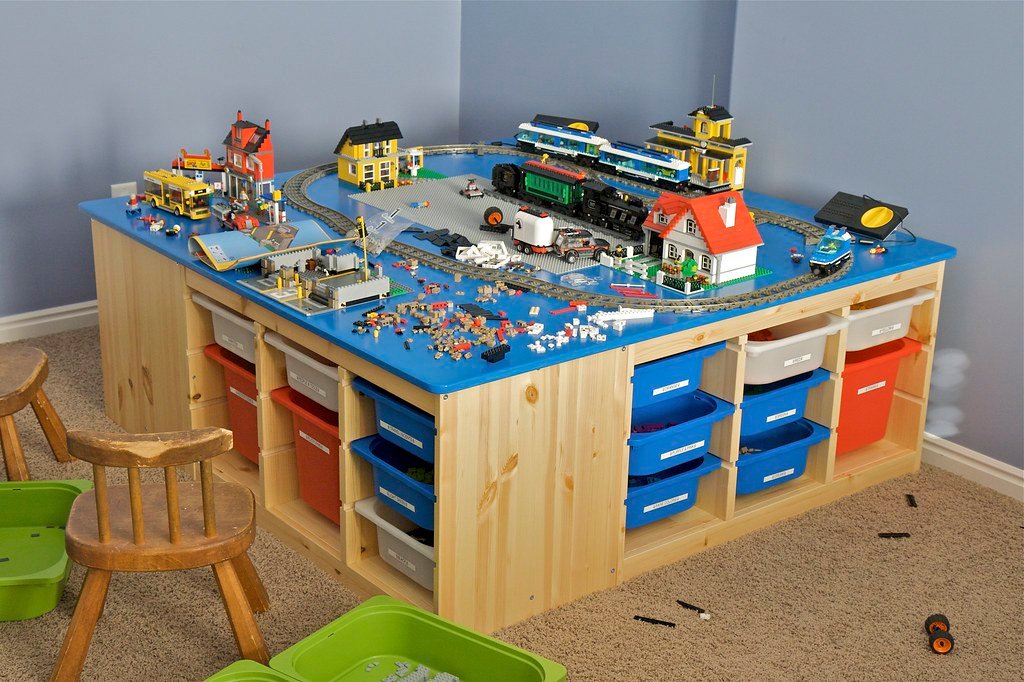
Most parents don’t need another decluttering tutorial. What they need are family organization systems that actually work beyond the first week.
I spent an entire Saturday decluttering a playroom. Sorted through every bin, donated three bags of toys, labeled everything that remained. The room looked magazine-worthy. I took a photo because I knew it wouldn’t last.
It didn’t. Forty-eight hours later, the floor was covered again.
I stood in the doorway feeling that specific brand of parental frustration that comes from doing something perfectly and watching it immediately unravel. The decluttering hadn’t failed because I did it wrong. It failed because I was treating a systems problem with a one-time solution.
Here’s the thing most content about home organization with kids won’t tell you: if clutter keeps coming back, you didn’t fail at decluttering. You succeeded at decluttering. Then you went back to living in a home without functional systems to support how your family actually operates.
We’ve been sold a myth that goes something like this: If you just removed enough stuff, your home would stay organized. It’s appealing because it suggests a finish line. Do the work once, reap the benefits forever. But anyone dealing with clutter with children for more than a week knows that’s not how family homes work.
📌 Reality Check
If decluttering worked on its own, most parents would only need to do it once.
The real problem isn’t that you have too much stuff, though you might. The real problem is that most families are operating without systems that match their actual behavior patterns. Decluttering removes objects. It doesn’t change what happens next.
Why Decluttering Your Family Home Feels Like Progress (But Rarely Lasts)
Decluttering provides immediate visual satisfaction. You can see the difference. The shelves look cleaner, the floor is visible, the bins are half-empty instead of overflowing. Your brain registers this visual order as completion, as problem solved. That’s why it feels so good.
But that feeling is deceptive.
Visual Relief vs Behavioral Change
When you remove half the toys from a playroom, you haven’t changed how toys get used or where they go when playtime ends. You’ve just created temporary breathing room. The underlying patterns—how kids access toys, where things get dropped, what happens during cleanup—remain exactly the same.
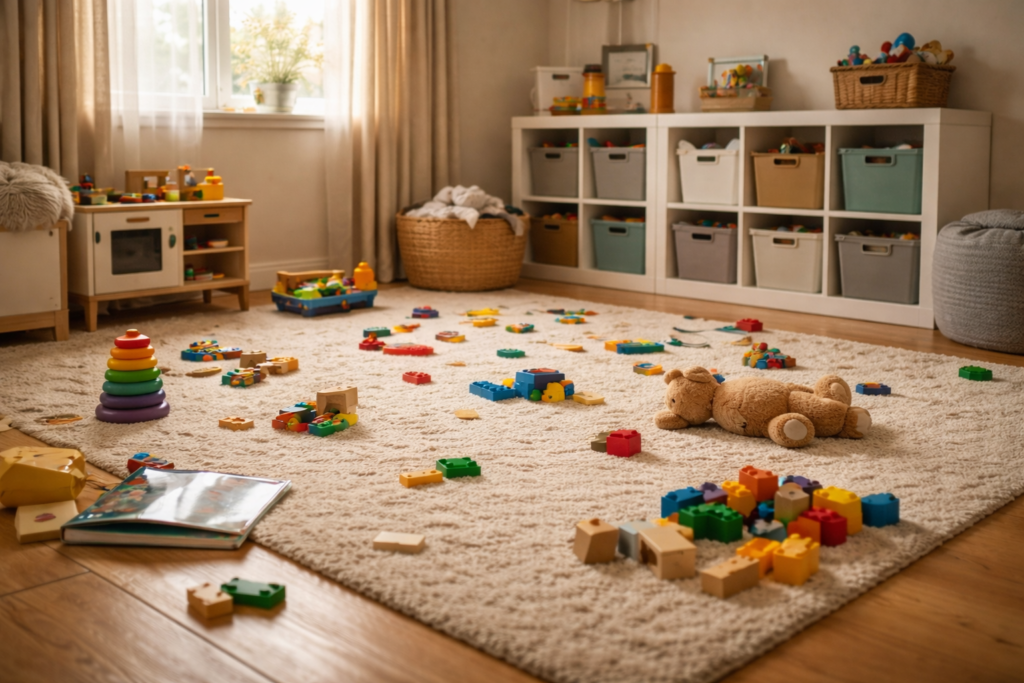
Less stuff definitely makes spaces easier to manage. But it doesn’t automatically create new habits. Your child who left toys scattered across the floor before decluttering will leave toys scattered across the floor after decluttering. There will just be fewer of them initially.
The brain is wired to notice visual change and interpret it as meaningful progress. You walk into a decluttered room and feel accomplished because everything looks different. That emotional payoff reinforces the belief that you’ve solved the problem. Then life continues, stuff accumulates, and the cycle repeats.
This breakdown from That Practical Mom shows exactly why decluttering feels productive but rarely changes what happens next.
The Return of Clutter
Here’s what actually happens after most decluttering sessions: for a few days, everyone is conscious of the newly organized space. Things get put away more carefully because the “after” state is still fresh. Then normal life resumes. Backpacks get dropped by the door. Mail piles up on the counter. Clean laundry migrates from the basket to the couch to the floor.
The stuff flows back in because the behavior never changed. The family never established where things actually live or how they move through the space. Kids didn’t fail to maintain the setup. The setup never included a maintenance plan in the first place.
I see this pattern constantly in my work creating educational materials for families. Parents assume that once they’ve taught something clearly, kids should just remember and execute. But repetition, routine, and systems are what make things stick. One explanation isn’t enough. One decluttering session isn’t enough.
📊 Before / After / Two Weeks Later
→ Week 1: Visual declutter complete
→ Week 1-2: No system change implemented
→ Week 3: Clutter returns to baseline
⚠️ Decluttering removes objects. Organization changes behavior.
Decluttering, Organizing, and Maintaining Are Three Different Jobs
Most people use these terms interchangeably, which is part of why their efforts fail. These are three distinct processes that require different skills and produce different results.
Decluttering
This is the removal phase. You’re making decisions about what stays and what goes, reducing the total volume of possessions in a space. Decluttering is tactical and often emotionally satisfying because you can see immediate results. You fill donation bags, clear surfaces, create visual space.
Decluttering is valuable. It absolutely makes the next steps easier. But it’s a one-time or periodic activity, not an ongoing system. You can declutter a junk drawer in twenty minutes. That doesn’t mean the drawer will stay functional without additional structure.
Organizing
This is where things get more complex. Organizing means assigning homes—deciding where categories of items live and creating systems for how they’re accessed and returned. It requires decision-making about how your family actually functions, not how you wish they functioned.
Good organization for families acknowledges reality. If your kids never hang up their coats in the closet, the closet isn’t the right system. A row of hooks by the door that matches their actual height and behavior pattern is better organizing, even if it’s less aesthetically pleasing.
This is the phase where most parents get stuck because it requires ongoing input from the people using the space. You can’t organize for your family without understanding their patterns. Where do things naturally accumulate? What gets used together? What’s too complicated for a tired seven-year-old at the end of the day?
Maintaining
Here’s the part everyone underestimates: maintenance is the daily work of keeping systems functional. It’s putting things back, doing quick resets, catching clutter before it compounds. Maintenance isn’t one big effort. It’s small, consistent actions that prevent entropy.
In a family home, maintenance is collaborative. It can’t fall entirely on one person, but it also can’t happen without clear systems that everyone understands and can execute. This is why organizing matters so much—if your systems are too complicated, maintenance becomes unsustainable.
📋 The Three Tasks Compared
| Task | What It Does | Time Horizon | Why It Fails |
|---|---|---|---|
| Decluttering | Removes items | Short-term | Doesn’t change habits |
| Organizing | Assigns systems | Medium | Too complex for daily life |
| Maintaining | Sustains order | Ongoing | No reset built in |
I’ve watched teachers manage classroom setups for years. The ones who succeed aren’t the ones with the prettiest systems. They’re the ones whose setups are so simple that a substitute teacher can maintain them. Family homes need that same level of functional clarity.
Why Homes With Kids Need Different Rules
The organizing advice that works for childfree adults or empty nesters doesn’t translate directly to families with children. This isn’t because kids are inherently messy or careless. It’s because children have different cognitive capacities, different needs for accessibility, and different relationships with shared space.
Shared Spaces vs Personal Spaces
In adult-only homes, most spaces are personal or semi-personal. You control the kitchen because you’re the primary user. Your living room reflects your preferences. Bedrooms are private.
Family homes operate differently. Kitchens serve multiple people with different schedules and different capabilities. Living rooms get used for homework, play, projects, and relaxation simultaneously. Entryways become dumping grounds because everyone moves through them at different times with different needs.
Organizing shared spaces requires thinking about multiple users with competing priorities. The coat hooks can’t be at adult height if you want kids to actually use them. The snack cabinet can’t be organized by category if it means a child can’t find what they need independently.
Personal spaces—individual bedrooms—can have different rules because they impact fewer people. Children’s rooms don’t need to meet the same standards as shared living spaces. That distinction matters.
Age-Based Capacity
Here’s what adults often expect: clear instructions lead to consistent execution. “Put your shoes in the bin” should result in shoes consistently appearing in the bin.
Here’s the reality of child development: executive function—the ability to plan, organize, and follow multi-step processes—develops gradually throughout childhood and adolescence. A six-year-old who can’t remember to put shoes away without prompting isn’t being defiant. They’re being six.
Family organization systems need to account for what different ages can actually manage. Expecting a first-grader to maintain a complex sorting system is setting everyone up for frustration. A single large bin for “outdoor gear” is more realistic than separate containers for shoes, jackets, hats, and gloves.
As kids get older, systems can become more sophisticated. But they still need to match actual capacity, not ideal capacity. Eighth-graders can handle more complex tasks than first-graders, but they’re also managing more competing demands on their attention.
According to the CDC’s positive parenting guidelines, matching expectations to developmental stages reduces frustration for both parents and children while building competence over time.
Ownership Beats Instructions
The difference between “put this away” and “this lives here” might seem subtle, but it’s fundamental. Instructions require memory and motivation every single time. Ownership—knowing that an item has a specific home—creates automatic behavior.
When kids understand that backpacks live on the hooks by the door, they don’t need to be told where to put them. The system creates the behavior. When every item requires a new decision and a reminder, maintenance collapses.
This is why labeling works for some families and fails for others. Labels that state the obvious (“shoes”) don’t add value. Labels that clarify ownership within categories (“art supplies”) or process (“clean” vs “dirty” in a laundry system) actually support function.
Family Organization Systems That Work With Kids, Not Against Them
Functional setups aren’t about perfect categories or beautiful bins. They’re about creating approaches simple enough to maintain during real life—when someone is sick, when schedules are packed, when everyone is tired.
Zones Instead of Categories
Stop trying to organize by perfect categories. Instead, create zones based on where items get used and what happens in different areas of your home.
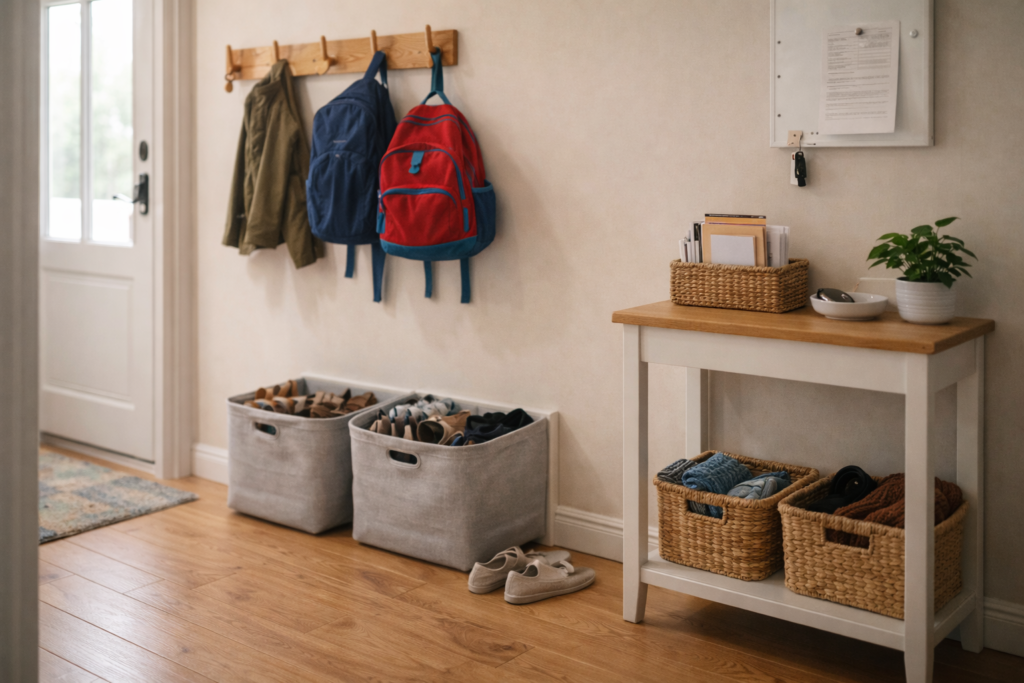
A drop zone near the entry handles everything that comes in from outside: bags, shoes, jackets, mail, keys. It doesn’t matter that these items belong to different categories. They all need to be accessible in the same location because they’re all part of the coming-and-going process.
A launch pad for school mornings might include backpack hooks, a spot for signed forms, tomorrow’s clothes, and whatever needs to go out the door. Again, these items have nothing in common except timing and function.
Containment beats perfection. If the drop zone catches 80% of the incoming chaos, that’s more functional than a beautiful entryway closet that nobody uses because it requires three extra steps.
Visual Limits
Here’s a system that works reliably: bins define limits, not rules. When the toy bin is full, something has to leave before something new can enter. When the art supply drawer is overflowing, we sort through and remove what’s dried out or unused.
This creates a natural check on accumulation without requiring constant vigilance. The physical container enforces the limit. Kids can see when something is full. The consequence (can’t close the lid, can’t fit new things) is immediate and logical rather than arbitrary.
This works for adult spaces too. I use this principle for my teaching materials. When the file box for a specific grade level is full, I evaluate what’s actually getting used and remove what isn’t. The container creates the decision point.
Reset Points
Maintenance can’t be constant. It also can’t wait until things are completely out of control. Reset points—specific times when everyone does a quick sweep—keep systems functional without requiring perfect moment-to-moment maintenance.
An end-of-day reset might take ten minutes. Everyone returns items to their zones, clears surfaces, moves things from temporary spots to permanent homes. It’s not deep cleaning. It’s preventing tomorrow from starting with yesterday’s chaos.
A weekly reset might be more thorough—sorting mail, clearing out the car, restocking supplies, dealing with items that have been sitting in the “decide later” zone. Building these patterns into healthy family routines ensures they become automatic rather than aspirational.
💡 If a system requires motivation, it will not survive childhood.
🏠 Simple Zone Diagram:
✓ Entry: Drop zone (bags, shoes, jackets, mail)
✓ Kitchen: Launch pad (school papers, tomorrow’s needs, daily essentials)
✓ Shared Living Space: Activity containment (current projects, daily-use items, reset basket)
Why “Staying Organized” Is the Wrong Goal
We talk about “staying organized” as if it’s a permanent state you achieve and maintain through discipline. But homes aren’t museums. They’re active spaces where people live, work, play, and make messes in the process of doing things.
The goal isn’t staying organized. The goal is being able to reset quickly when things inevitably fall apart.
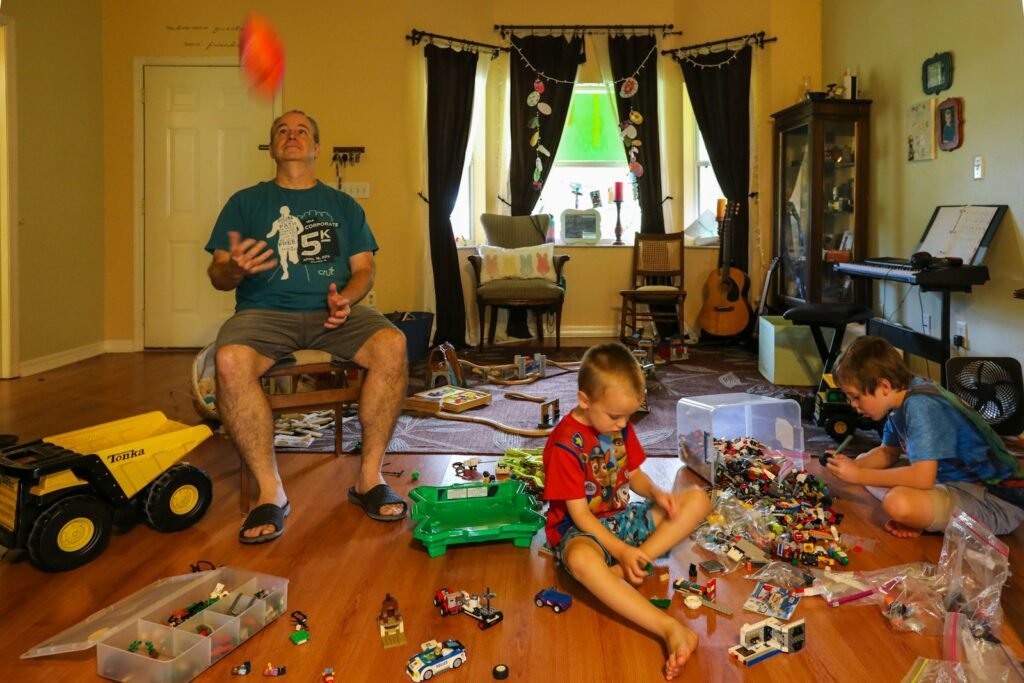
Home setups are dynamic. What works during the school year might not work during summer. What works when kids are in elementary school stops working when they hit middle school and their schedules explode. Systems need to evolve as needs change.
I’ve revised my teaching materials and home systems more times than I can count. Not because the previous version failed, but because what we needed changed. Children are in different developmental stages year to year. Daily rhythms shift. Static systems don’t accommodate growth.
Homes aren’t static environments either. Seasons change how spaces get used. Projects come and go. Family size changes. Someone develops a new interest that requires equipment. Expecting a single session to handle all of this is unrealistic.
“Resettable” beats “perfect.” A home that can return to functional baseline in fifteen minutes is more livable than a home that looks perfect but requires hours of work to maintain. When the bar for “organized enough” is achievable, maintenance actually happens.
This is why I emphasize systems over aesthetics in the educational materials I create. A colorful, elaborate setup that kids can’t maintain independently isn’t actually functional. A simple, sustainable system that matches their actual capacity is.
Building these sustainable rhythms means creating maintenance patterns that stick without requiring perfection. When routines become automatic rather than aspirational, they survive the chaos of real family life.
The Real Work Ahead
If you’ve been decluttering repeatedly and watching the same mess return, you’re not failing. You’re experiencing what happens when we mistake a tool for a solution.
Decluttering is valuable. It creates space and removes decision fatigue. But it’s only the first step. The actual work is designing systems that match how your family functions, not how you wish they functioned or how blogs say they should function.
Those systems need to be simple enough for tired kids and exhausted parents to maintain. They need built-in reset points so that mess doesn’t compound into overwhelm. They need to evolve as your family’s needs change.
And they need to define success differently. Not as a permanent state of order, but as the ability to restore order without resentment when things fall apart—which they will, because you’re living in your home, not staging it.
The National Association of Professional Organizers emphasizes that sustainable approaches focus on systems that support daily life rather than systems that require life to adjust around them. That distinction is critical.
A home that functions isn’t the one that stays clean. It’s the one that can be reset without resentment. And when maintenance becomes a shared responsibility through age-appropriate task distribution, sustainable routines become possible long-term.

